
Women Farmers Fuel Productivity and Possibility with Equipment Loans
By Heifer International | February 5, 2026
Access to cooperative-led financing allows one woman farmer in rural Uganda to invest in her farm — and reclaim time, income and agency.

February 19, 2026

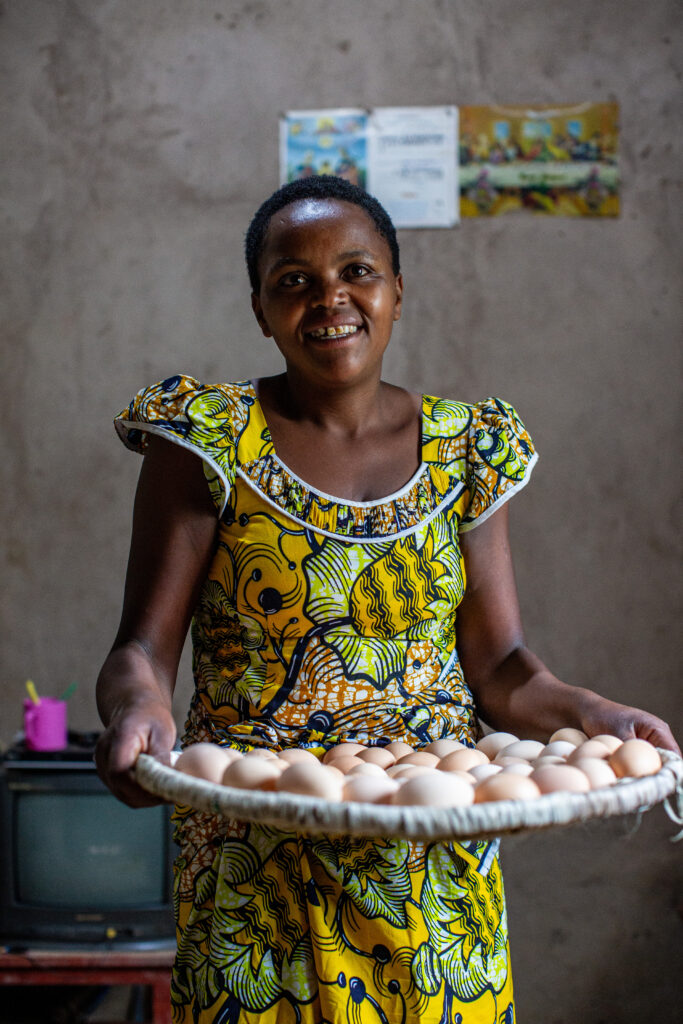
On Saturdays, Jeanne d’Arc Barakamfitiye sells eggs.
The steady sales create predictable income for her family and fuel the growth of her small livestock business. In her savings-and-loan group, Jeanne is known as an entrepreneur — someone others are eager to invest in and work alongside.
A few years ago, that kind of steady income felt out of reach. The mother of three was working in neighbors’ fields to make ends meet. Her husband’s wages weren’t enough to cover basic nutrition, and access to even small amounts of credit was uncertain.
Jeanne’s family lives in Rwanda’s Rulindo District, where many rural households struggle with poverty and malnutrition despite steady economic growth nationwide. Most of Rwanda’s population works in agriculture, yet low productivity, scarce land and reliance on rain-fed farming leave families vulnerable to food insecurity and climate shocks.
Jeanne’s situation began to change in October 2022, when she and her husband joined the PRISM project — the Partnership for Resilient and Inclusive Small Livestock Markets — in Rwanda. PRISM works in districts where poverty and malnutrition are most severe, helping farmers — especially women and youth — strengthen small livestock businesses and connect to functioning markets. By combining training, access to livestock and support for savings groups, the project aims to improve nutrition, increase incomes and build resilience.
As part of the PRISM project, Jeanne joined the Dukorere mu Mucyo self-help group, a small group of farmers who share common interests, goals and challenges. They meet regularly for business and technical training, save money together, lend to one another and make decisions collectively.
Through the group, Jeanne participated in livestock management and financial literacy training. PRISM also helped her build a standard chicken shed and provided 10 chickens. As the chickens began laying eggs, Jeanne’s family gained a reliable source of nutrition — and a steady source of income.
Self-help group meetings became a space for shared learning. Women and other farmers exchanged ideas about livestock care, soil health and kitchen gardens — practical knowledge that helped improve yields and strengthen food security.
For many women in rural Rwanda, that kind of collective structure is critical. Mukakimenyi Marie Rose, a PRISM project mentor, says older women in particular often felt isolated before joining self-help groups, unsure how to change their circumstances or invest in income-generating activities. Working in groups helps shift that dynamic, giving women a place to save, learn and plan for the future together.
“If you’re not in a group, you miss out on learning better ways to develop yourself.”
— Jeanne d’Arc Barakamfitiye
These networks of trust and shared responsibility also build social capital — shared relationships, norms and values that help people work together to solve problems and reach common goals. In farming communities, social capital helps farmers spread resources and knowledge, connect to markets and build more resilient livelihoods.
“Working in groups helped us get to know each other and share ideas,” Jeanne said. “The ideas we exchanged in the group led to the decision to expand the number of chickens, which resulted in more eggs, manure, and eventually allowed us to buy a cow. If you’re not in a group, you miss out on learning better ways to develop yourself.”
Self-help groups also pool savings, with members contributing small amounts at each meeting. Those savings are lent to members, creating a shared system of accountability. It also reduces risk, since women navigate important financial decisions together rather than in isolation.
Because Jeanne made regular contributions to her self-help group, she became eligible for small loans — financing she used to reinvest in her farm. And small group savings became a practical path to grow her farming business.
Through PRISM, women farmers and others also practice Passing on the Gift®, a cornerstone of Heifer International’s work that encourages participants to share the knowledge or assets they gain with others. Sometimes that gift is livestock. Other times, it’s building materials, training or mentorship. The result is a ripple effect that extends beyond any single household.
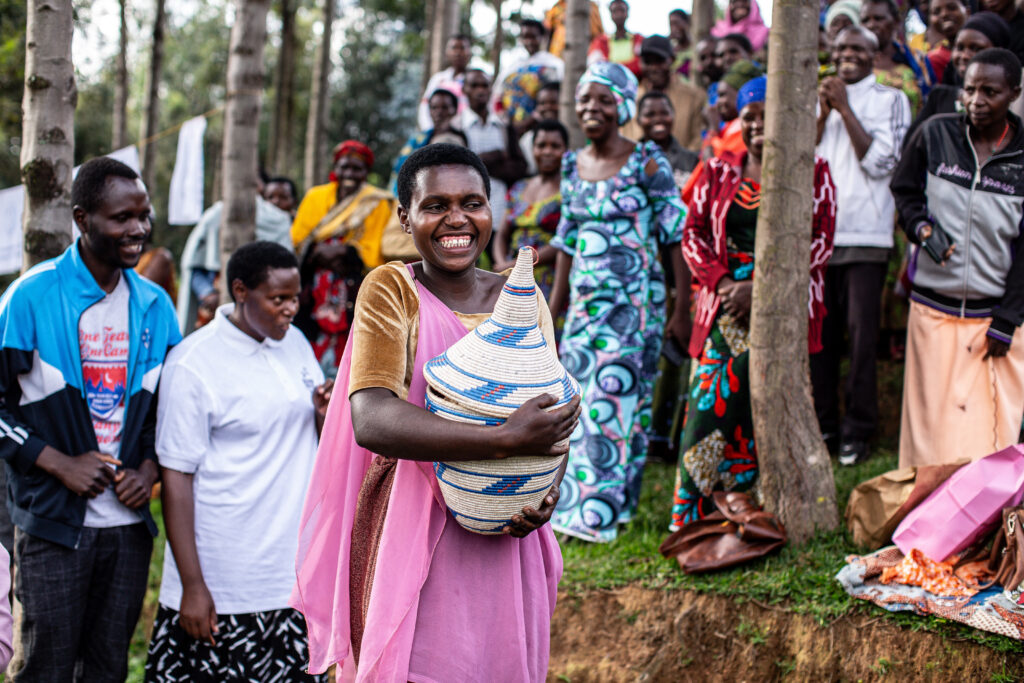
Izabiriza Consolée created one of those ripples. The 53-year-old mother of six received a pig through the project. Within months, her pig gave birth to multiple piglets, and over time, her herd grew to more than 20.
“Despite still being poor, I gave pigs to two of my fellow community members so they too could benefit,” she said.
One of the piglets went to Izabiriza’s neighbor, Habumuremyi Emmanuel. With that gift — and the guidance Izabiriza shared — Habumuremyi grew his farm from one piglet to three pigs, improving his family’s income and food security.
“She taught me valuable things, and I truly appreciate them,” Habumuremyi said. “My goal is to raise enough pigs to feed my cows so they produce milk to drink.”
Stories like these are common across PRISM communities, where progress is designed to be shared.
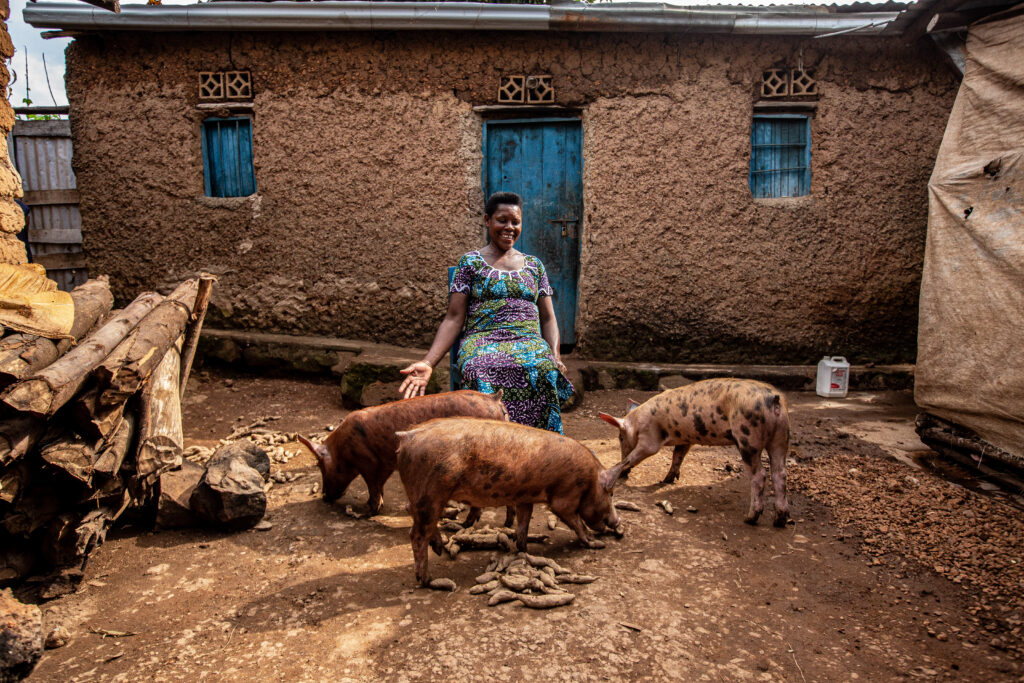
For many participants, collective action also opened the door to more formal financing.
Within two years, Jeanne and her self-help group had successfully passed livestock on to other farmers, and the group qualified for a loan through the Rwandan government’s Vision 2020 Umurenge Program, an initiative that expands access to credit and economic opportunity in rural communities. Jeanne used that group loan to grow her flock to 40 chickens, significantly increasing egg production.
That growth — and the predictable income it generated — helped Jeanne access additional financing. A loan from a local savings and credit cooperative organization (SACCO) allowed Jeanne to expand her business beyond poultry.
“That’s when SACCO gave us a loan, and we bought a cow,” Jeanne said. “Then we bought land. Now we have goats, a cow, chickens and even our own plot of land — all thanks to PRISM.”
As her egg sales became more predictable — every Saturday — trust grew. People who once hesitated to lend money to Jeanne now know she can repay it.
“Before working with PRISM, there were times I would ask for a loan and get denied because they thought I couldn’t repay it,” Jeanne said. “Now that the chickens produce eggs every Saturday, people are confident that if they lend me money, I’ll pay them back with egg sales.”
Jeanne’s experience is not unique. Across Rwanda, PRISM is helping women and other farmers build income and resilience by strengthening social capital and expanding access to finance through collective action.
The project works with nearly 36,000 farming households across 15 districts, with women making up at least half of all participants. From Jan. 1 to June 30, 2025, PRISM self-help groups saved more than $155,000 and issued over $161,000 in loans — capital that stayed in the community and was reinvested locally.
Average household income among participating families has nearly doubled since 2023, and 99 percent of women report medium to high participation in household decision-making.
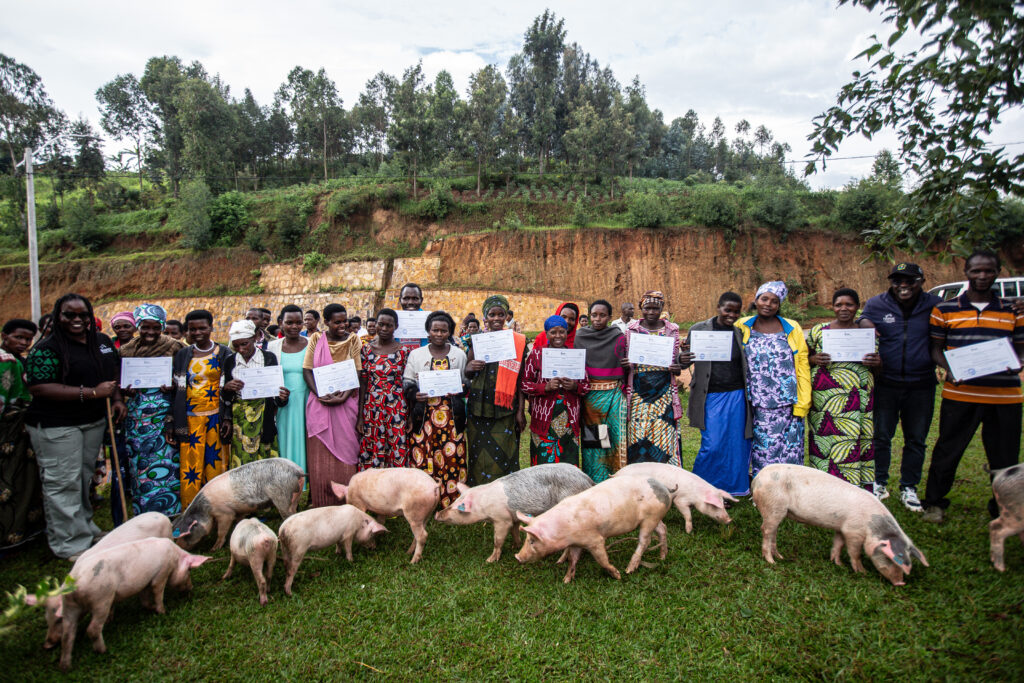
For families like Jeanne’s and Izabiriza’s, PRISM’s impact reaches beyond income.
With manure from her livestock, Jeanne’s family began growing vegetables at home, improving her household’s nutrition. For Izabiriza, participation in self-help groups reduced isolation and created purpose. “We have mentors who advise us on saving,” Izabiriza said. “Now I am a dignified elderly woman thanks to working with PRISM.”
When thousands of women like Jeanne and Izabiriza strengthen their farms and businesses, the effects go beyond individual households. It means more food in local markets, steadier incomes and stronger economic ties across entire communities.
Together, their stories reflect a broader truth: Women farmers are not just beneficiaries of development efforts. They are sources of knowledge, ingenuity and leadership — and powerful drivers of economic growth and food system change.
When women invest together, communities grow stronger.
By Heifer International | February 5, 2026
Access to cooperative-led financing allows one woman farmer in rural Uganda to invest in her farm — and reclaim time, income and agency.
Did you know?
You can add multiple resources to this cart! Feel free to keep browsing, add more resources, and get all of your resources in one package. Easy!
Cart is empty
Success!
Please be patient while we send you to a confirmation page.
We are unable to process your request. Please try again, or view common solutions on our help page. You can also contact our Donor Services team at 855.9HUNGER (855.948.6437).
Success!
Please be patient while we send you to a confirmation page.
We are unable to process your request. Please try again, or view common solutions on our help page. You can also contact our Donor Services team at 855.9HUNGER (855.948.6437).