Masuma, Rebeka Begum and Abdur stand with their water buffalo in Sarishapuri village, Rajshahi District. Photo by Heifer International/Russell Powell.
Rebeka Begum, a 36-year-old farmer and mother of three in northern Bangladesh, smiles when she talks about her livestock. She owns two dairy cows, which, she says proudly, produce five liters more milk per animal per day than they used to.
“I didn’t know about medications, deworming medicine, I didn’t know I had to feed that to the cows. After I did that, their health improved.” And they produced more milk. She also owns eight buffalos, she said, which she will fatten before taking them to market to sell for a profit.
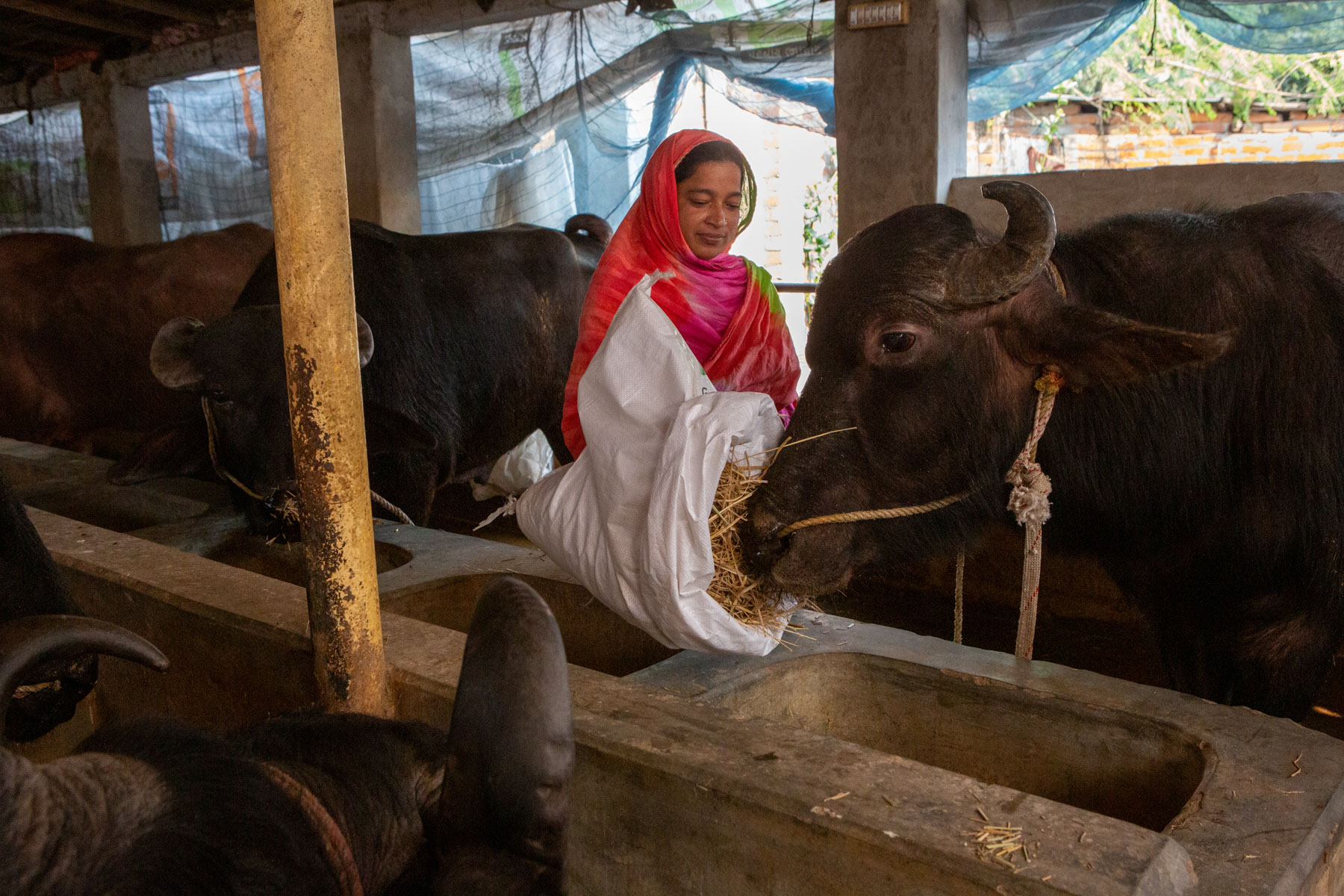
Rebeka feeds chopped fodder to her water buffalo in Sarishapuri village, Bangladesh. Photo by Heifer International/Russell Powell.
Demand for meat is high in Bangladesh and today Rebeka knows how to benefit from the market. For years, though, she faced significant obstacles to earning a living income as a smallholder farmer.
Despite working steadfastly to care for her livestock, producing safe, high-quality meat and dairy was a challenge. Rebeka’s knowledge of animal husbandry was minimal and her access to high-quality feed and veterinary care was limited. So was her access to formal credit and other financial tools — this is one of the biggest challenges farmers around the world face, especially women farmers, restricting their ability to build resilient, profitable businesses.
Livestock is a common source of income for rural households in Bangladesh, yet many farmers face similar limitations. What’s more, livestock markets throughout the country are largely informal, with weak sanitary controls and little regulation, leaving farmers unable to garner fair prices.
Rebeka’s family’s circumstances worsened when her husband, Muhammed, a miller, lost customers to a new grain mill that had opened nearby. The couple struggled to provide their children with proper nutrition. By the time their firstborn was old enough to attend school, they could only just manage to pay tuition; sometimes they paid late.
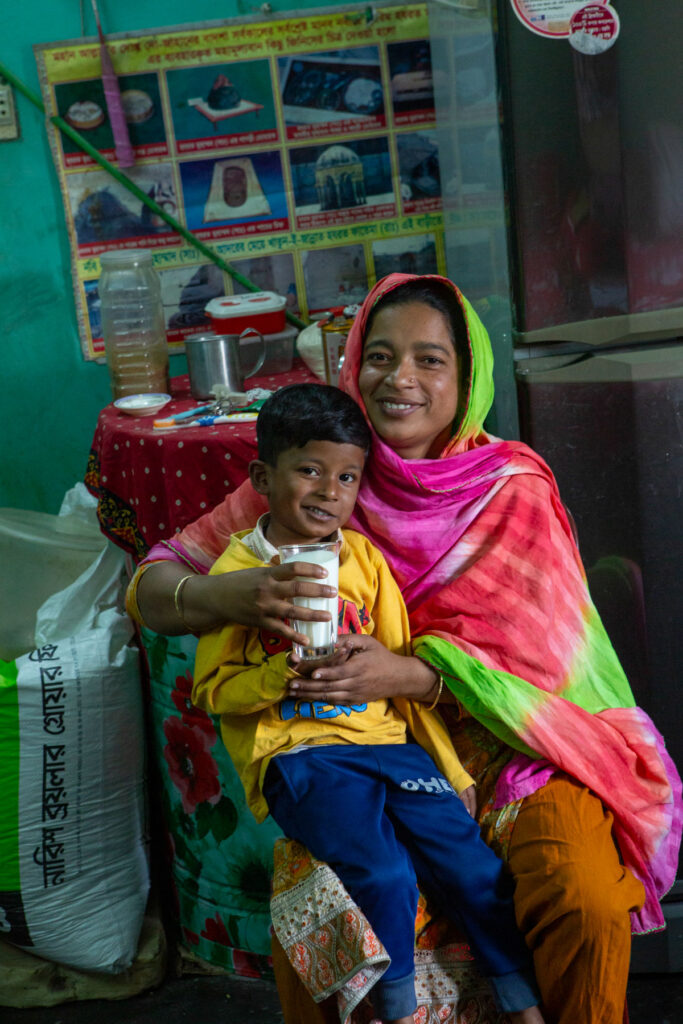
Rebeka helps her son Mohammad drink a glass of milk inside their home in Sarishapuri village, Bangladesh. Photo by Heifer International/Russell Powell.
Several years ago, Rebeka learned of a Heifer International project partnering with women farmers across thirteen subdistricts in Bangladesh. It provides training in safe and hygienic livestock management and meat processing as well as access to quality inputs and services and competitive markets. Called the Women’s Enterprises for Safe Beef and Goat Meat in Bangladesh, the project is rooted in the knowledge that women farmers are foundational to social and economic progress in Bangladesh.
Rebeka learned through the project how to select and care for better livestock breeds for meat and dairy — the problem was, she didn’t have enough money to purchase those breeds. This is where her community and the Heifer project stepped in.
Rebeka was able to take a low-interest loan through the women’s cooperative she belonged to, which Heifer had partnered with, and combine it with money from her own savings. Using those funds, she purchased a breed of cow that would produce more milk than the indigenous cows she’d owned and milked until then. She then turned her indigenous cows into more capital: she sold them and used the profits from that sale along with another low-interest loan from the Heifer project to purchase her buffalo. Over the course of these transactions, Rebeka became empowered: to select and raise healthy animals, to earn a living income and to support her family.
Through the cooperative, Rebeka was also able to purchase a grass chopping machine, investing some of her own money and matching it with a loan from the cooperative. “Now I can prepare more fodder in less time,” said Rebeka. “Before I had a machine, but it was very slow. The new machine is twice as efficient as the old machine.”
Then, once again combining some of her own money with a loan from Heifer, Rebeka was able to install a biogas system in her home, which converts cow dung into gas for cooking. Rebeka gives the byproduct from the biogas system — fertilizer — to other farmers from her cooperative. This is her way of Passing on the Gift®.
“When you give a gift to someone you develop a relationship with that person,” she said. “Also, when a person gets a gift, they feel happy. Seeing their happiness, you feel good.”
Since enrolling in the project, engaging in trainings and accessing safe, formal credit to invest in her farm, Rebeka’s income has increased. She’s been able to help her husband purchase a new grain mill. The couple has purchased a new refrigerator and built an indoor bathroom. They can afford to feed their children a balanced diet. “Now I can meet all my children’s needs,” said Rebeka. “If they ask for new clothes, new shoes, I can give it to them.”
She and Muhammed can also afford to pay for their children’s education, including their daughter’s. At an age when Rebeka was already a mother, her daughter, Masuma, is still in school. Now four grades past the point when her mother was pulled from school to marry her father, Masuma has no plans to stop. She wants to be a doctor.
“It is my life goal to serve people,” said Masuma with a shy smile.
A Life-Changing Loan, a Pathway to Prosperity in Bangladesh
By Alyssa Cogan and Esther Kahinga|January 10, 2024
Access to credit remains one of the greatest challenges for smallholder farmers, especially women. But when Marzan joined a Heifer-supported self-help group, she was finally connected to the network of support she needed to invest in her future.
Please be patient while we send you to a confirmation page.
We are unable to process your request. Please try again, or view common solutions on our help page. You can also contact our Donor Services team at 855.9HUNGER (855.948.6437).
-
includes to cover payment processing costs.
Give in Honor
You'll have the opportunity to fill out a free card after your donation
Details
,
Success!
Please be patient while we send you to a confirmation page.
We are unable to process your request. Please try again, or view common solutions on our help page. You can also contact our Donor Services team at 855.9HUNGER (855.948.6437).
Your Donation Amount
/mo
/yr
includes to cover payment processing costs.
Give in Honor
You'll have the opportunity to fill out a free card after your donation