Have you ever considered the humble egg as a key to unlocking health and opportunities for future generations? Aside from being a staple for breakfast and a source of vital nourishment, eggs, along with chicken, have much more to offer.
Enter Hatching Hope, a partnership between Cargill and Heifer International designed to combat hunger and poverty through poultry farming. Through activities like songs, skits and murals, this initiative harnesses the power of poultry education to inspire young minds, nurture future farmers and challenge unfavorable beliefs surrounding chickens and eggs. Follow along to uncover three benefits of poultry education in today’s rural learning environments.
1. Boosting Knowledge through Nutrition Awareness
Students enjoy freshly prepared eggs as a snack at Aolo Primary School in Kawene, North Kamagak, Homabay County, Kenya. Photo by Heifer International/Allan Gichigi.
Rich in vitamins, zinc, choline and iron, eggs boost both physical and cognitive development — advantages critical for growing children. The high satiety index of eggs also helps foster a feeling of fullness, which enables students to focus on learning without hunger’s distraction.
“Teaching a child on an empty stomach is really challenging,” explained Madam Goretty, head teacher at Aolo Primary School, where Hatching Hope Kenya conducted poultry education in 2022. “Some of them miss lunch. They may even go without supper.”
However, with an understanding of poultry’s nutritional perks, children and teachers alike have become enthusiastic advocates for proper nutrition, embracing healthier eating habits when possible and sharing knowledge about the dietary advantages of poultry within their schools and broader communities.
2. Planting Seeds for Agricultural Careers
During a poultry farming lesson at Aolo Primary School in Kawene, North Kamagak, Homabay County, Kenya, students proudly display their chicken and egg drawings. Photo by Heifer International/Allan Gichigi.
In rural areas, where 80% of the world’s poor reside and farm, poultry education lays the groundwork for careers in agriculture as young students learn about poultry’s central role in reducing poverty, job creation and strengthening local economies.
The appeal of poultry farming lies in its accessibility. With fewer resources or investments required compared to other livestock, chicken rearing catalyzes transformation among low-income families in search of economic opportunity.
These learnings nurture aspirations and forge life skills that have the potential to influence both children’s personal paths and the overall prosperity of their communities.
“Farming is a career,” said Stacy, an eighth grade student at Aolo Primary School. “In my home, I can say that my parents, the main thing they do is farming. That’s how we can have the basic needs [met] in the family. So, I think it’s … good to be [a] farmer.”
3. Shattering Myths and Promoting Equality
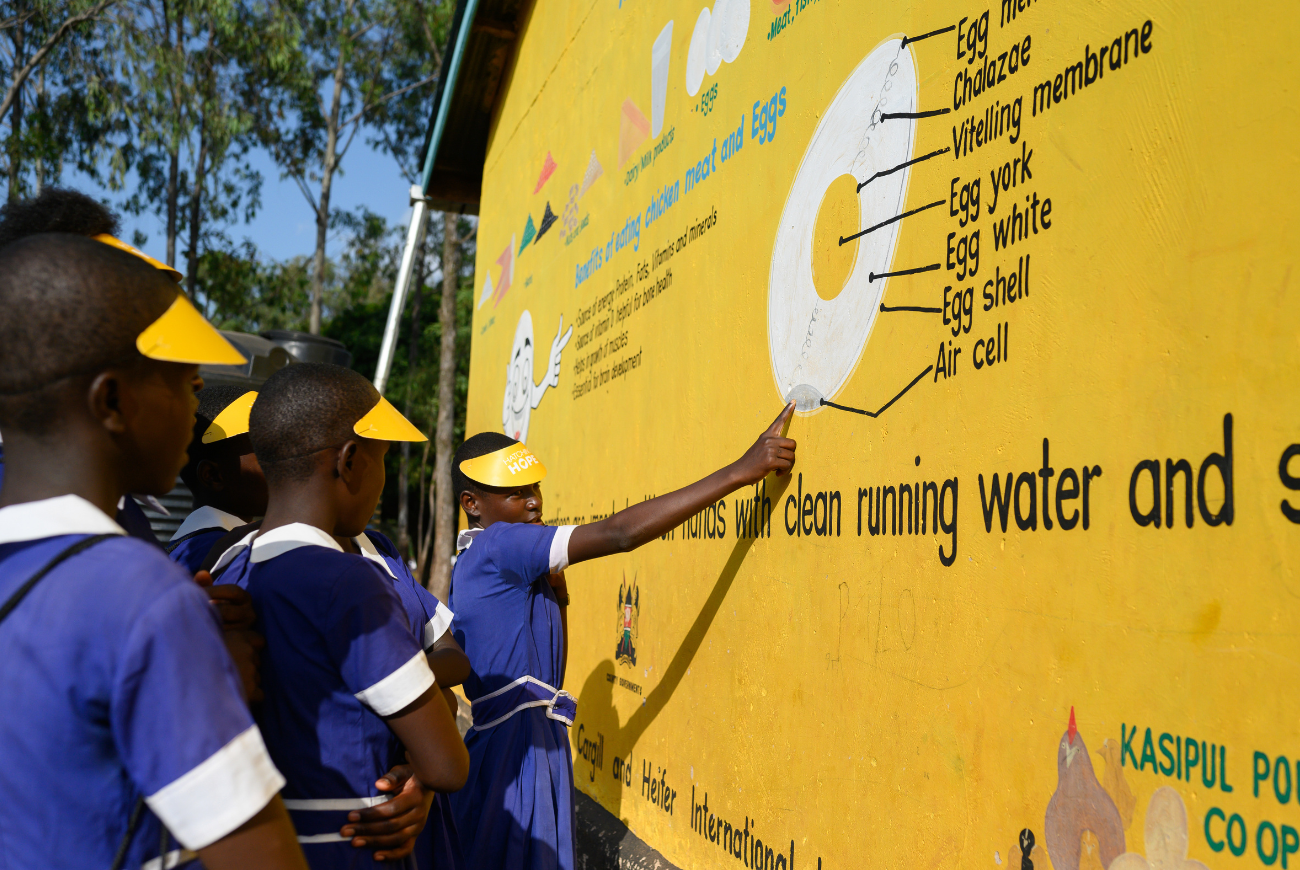
Students study a mural about chicken and egg consumption at Aolo Primary School in Kawene, North Kamagak, Homabay County, Kenya. Photo by Heifer International/Allan Gichigi.
In Kenya, for example, Hatching Hope collaborated with schools to teach students that it’s acceptable for women and girls to eat chicken and eggs. Classrooms also promoted gender equality by using poultry education to encourage women and girls to participate in raising poultry — something that would typically go against social norms.
This approach goes beyond enriching students’ understanding of affordable and locally available foods to create a more informed and equitable society free from the constraints of traditional taboos.
By A’Melody Lee Jacobi and Elizabeth Oywaya|October 8, 2021
Eggs are packed with all kinds of proteins and vitamins to keep us healthy. But these nutrient powerhouses are also a sustainable food, key to eliminating hunger and poverty.
Please be patient while we send you to a confirmation page.
We are unable to process your request. Please try again, or view common solutions on our help page. You can also contact our Donor Services team at 855.9HUNGER (855.948.6437).
-
includes to cover payment processing costs.
Give in Honor
You'll have the opportunity to fill out a free card after your donation
Details
,
Success!
Please be patient while we send you to a confirmation page.
We are unable to process your request. Please try again, or view common solutions on our help page. You can also contact our Donor Services team at 855.9HUNGER (855.948.6437).
Your Donation Amount
/mo
/yr
includes to cover payment processing costs.
Give in Honor
You'll have the opportunity to fill out a free card after your donation