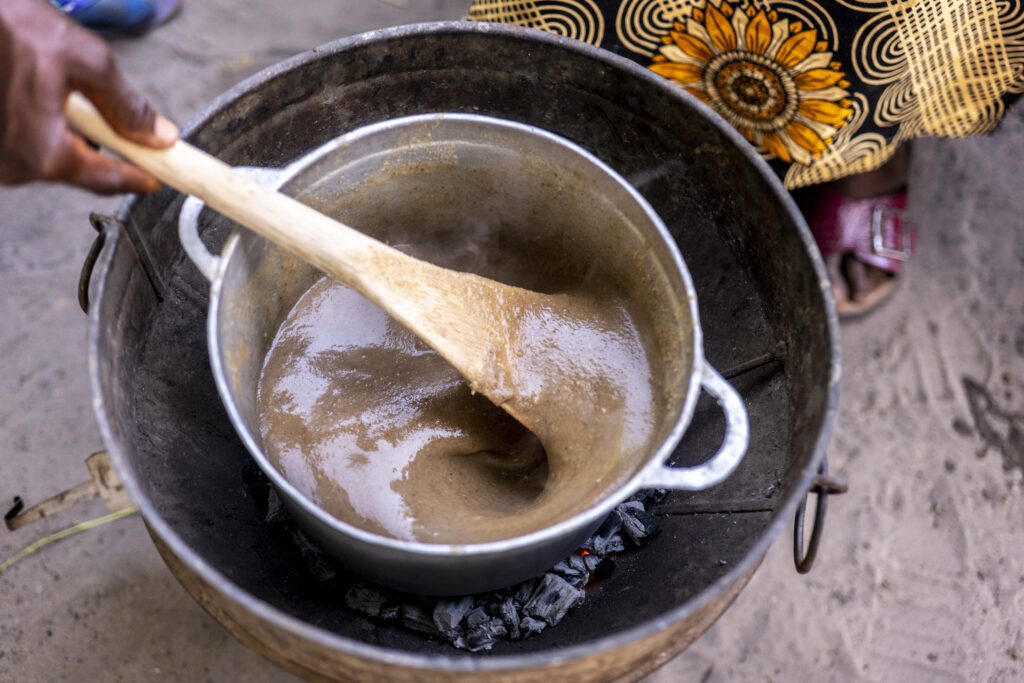
Grains used to make fortified porridge for children in Diacounda, Senegal. Photo by Heifer International/Sylvain Cherkaoui.
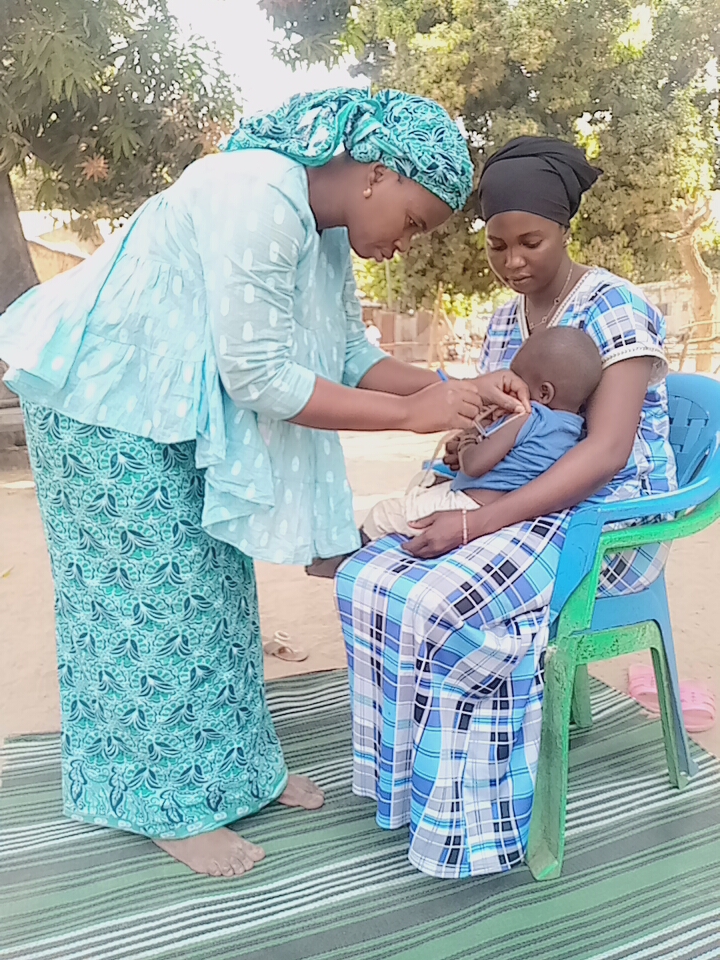
Sounkary Seydi, left, measures a child’s arm to check for early signs of malnutrition. Photo by Heifer International/Younoussa Mballo.
In Aloutte Mandingue, Senegal, the day starts early, before the heat sets in and while household work is already underway. For Sounkary Seydi, 28, a mother of four, the morning is full — caring for her children, preparing food and tending to the home — before she steps beyond it to care for others.
Like many families in her village in the municipality of Diacounda, Sounkary depends on small-scale farming. What they grow often determines what they eat. Rainfall is unreliable, and when harvests fall short or income tightens, meals narrow to what is available, often basic staples like rice, millet and maize that fill the stomach but do not always provide enough nourishment.
In this setting, a child’s health can decline rapidly. A full stomach does not always mean proper nutrition, and water may be close but not always safe to drink. Illness, especially diarrhea, drains what little the body holds, and a child can lose weight in days.
For years, Sounkary said, families lived with that instability. Hygiene was inconsistent, and malnutrition was common, especially among children and breastfeeding women. Many mothers lacked clear guidance on feeding practices or early warning signs when a child’s health was declining. Even when nutritious foods were available, they were not always given to children first. In those days, nearly 1 in 20 children in the area were affected by acute malnutrition.
“Before the start of the KAYRA project, our village was facing serious hygiene and malnutrition challenges,” Sounkary said, referencing a Heifer Senegal initiative focused on improving child nutrition through community-led support. “We had no structured organization to address these issues. Our neighborhoods and households were poorly maintained, and children’s health was deteriorating. The arrival of the KAYRA project changed everything.”
Through KAYRA, Sounkary became one of the village’s Model Mothers — a role defined by trust and responsibility. Model Mothers are not outsiders or specialists. They are women from the community, known for how they care for their own children and their willingness to help others.
The concept took shape as women gathered and spoke openly about children losing weight, recurring illness and what to do next.
“As a Model Mother, I am committed to sustaining these activities even after the project ends. We have learned to be autonomous and responsible.”
— Sounkary Seydi, Model Mother
From those discussions, they chose to organize — not as individuals, but as a group with shared accountability.
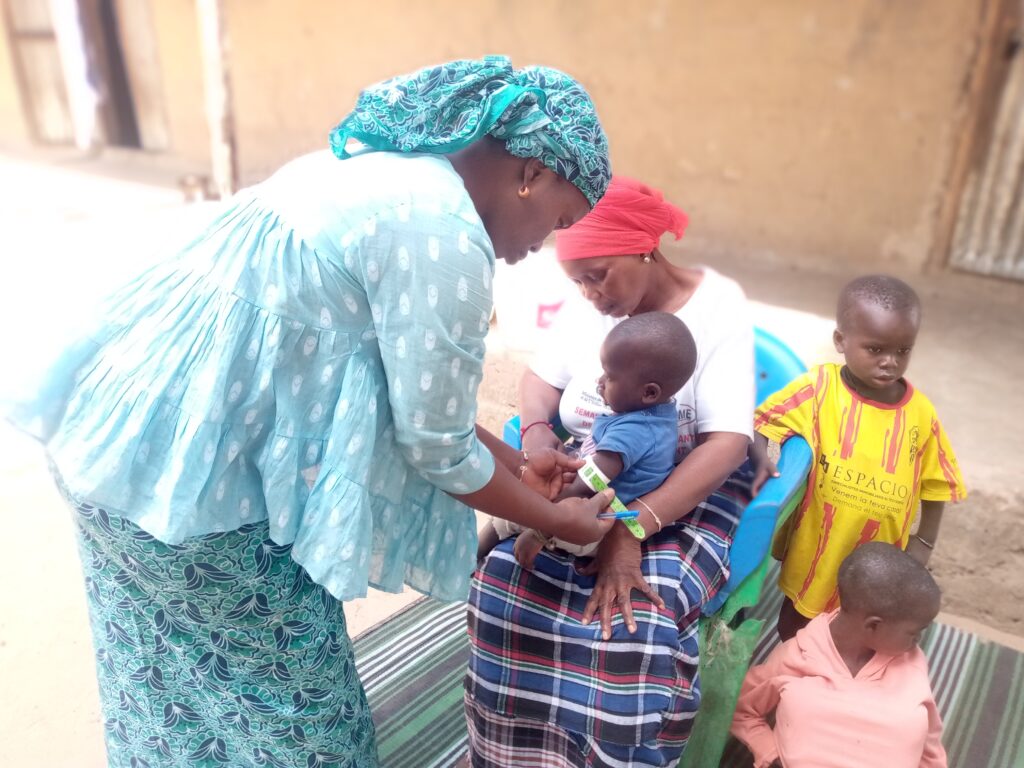
During a home visit in Diacounda, Sounkary, left, checks a child’s growth while speaking with the family. Photo by Heifer International/Younoussa Mballo.
Through the project, Sounkary and others received training in nutrition, hygiene, growth monitoring and food preparation. They practiced together, and then began applying what they learned in their own homes and passing it on to others across the village.
The KAYRA project closed in 2025, but today the work continues. Sounkary and others still meet with mothers regularly, sharing what they have learned and walking through feeding practices, handwashing and safe food preparation. They teach families to spot early signs of malnutrition and know when to act.
At group gatherings, Model Mothers measure children’s arms with a color-coded mid-upper arm circumference (MUAC) band to monitor children’s growth. Screening now reaches more children than before, rising from about 68 percent to more than 83 percent. When concerns appear, mothers respond quickly. Some children receive care at home with nutrient-rich porridge, while others are referred to local health facilities before their situation worsens.
“Today, I am proud to say that behaviors have changed,” Sounkary said. “Women are more aware of health and nutrition issues and are actively involved in prevention.”
A fortified porridge made from local grains provides key nutrients for young children in Aloutte Mandingue, Senegal. Photo by Heifer International/Sylvain Cherkaoui.
The impact extends beyond individual households. Under the leadership of Sounkary and nearly 30 other Model Mothers, the community built a granary stocked with locally grown crops. Families contribute what they can — millet, rice, sorghum — creating a collective reserve. The flour prepared from these grains becomes porridge, a steady source of nutrition for children. Across communities, similar efforts have brought together more than 50,000 kilograms of crops.
Many of these same women also take part in village savings-and-loan groups, setting aside small amounts of money each week and accessing loans when needed. This allows families to pay for food, medical care and other essentials that support children’s health.
At home, gardens have taken root and meals include more variety. Across the village, women organize weekly clean-up days, restoring shared spaces and creating a cleaner, healthier environment for their children.
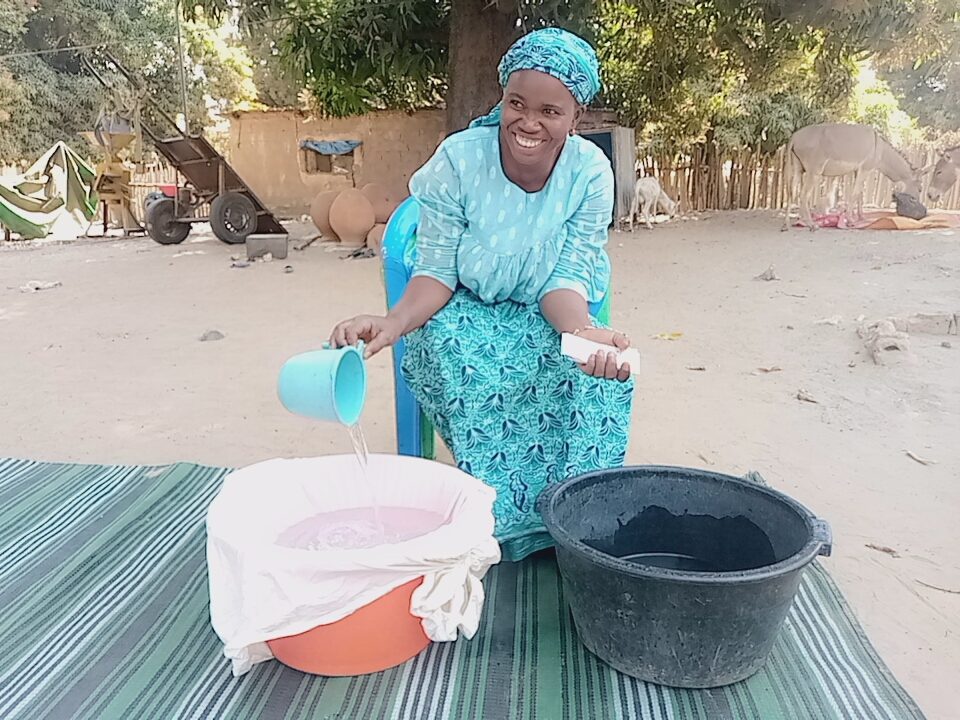
In Aloutte Mandingue, Senegal, Sounkary treats water at home, a practice Model Mothers use to reduce illness and support child nutrition. Photo by Heifer International/Younoussa Mballo.
Inside the home, small changes carry weight, from making water safe to drink to preparing meals with greater care and using iodized salt, which helps children get vital nutrients.
The difference is visible in families too. In some households, men have begun to take a more active role in bringing children to health visits or stepping in when women have other obligations.
Over time, malnutrition rates in the area have fallen from 4.5 percent to 2 percent.
“I cannot conclude without sincerely thanking the KAYRA project for the changes it has brought to our households,” Sounkary said. “Thanks to KAYRA, our children are growing up healthier, and our communities are living in a cleaner and safer environment.”
“As a Model Mother, I am committed to sustaining these activities even after the project ends. We have learned to be autonomous and responsible,” she said.
Please be patient while we send you to a confirmation page.
We are unable to process your request. Please try again, or view common solutions on our help page. You can also contact our Donor Services team at 855.9HUNGER (855.948.6437).
-
includes to cover payment processing costs.
Give in Honor
You'll have the opportunity to fill out a free card after your donation
Details
,
Success!
Please be patient while we send you to a confirmation page.
We are unable to process your request. Please try again, or view common solutions on our help page. You can also contact our Donor Services team at 855.9HUNGER (855.948.6437).
Your Donation Amount
/mo
/yr
includes to cover payment processing costs.
Give in Honor
You'll have the opportunity to fill out a free card after your donation