How do we ensure that the voices, priorities and visions of smallholder farmers — especially smallholder women farmers — inform and guide rural development strategies? This question, raised repeatedly at global forums, is often discussed without the farmers themselves at the table.
When women smallholder farmers are at the table — like they were at a recent event marking the International Year of the Woman Farmer — the value of their local wisdom, experiences and insights comes to the fore. It is not just a question of hearing their stories, inspiring as they are; it is also important to provide them the space and the trust to lead the conversation and point us toward crafting more sustainable, plentiful and equitable food systems in partnership with them.
The March 10 event, hosted by Heifer International and titled She Feeds the World: Women Smallholder Farmers Driving Positive Food Systems change, featured a woman farmer from Ecuador and one from Kenya who both began from very modest origins to develop into leaders for communities of women who are pursuing vibrant livelihood opportunities. Joining the dialogue were Margaret Zeigler, U.S. representative for the Inter-American Institute for Cooperation on Agriculture (IICA); Nicoline de Haan, director of the CGIAR Gender Equality and Inclusion Accelerator; and Neena Joshi, senior vice president for Asia programs at Heifer.
For Kenyan farmer Julian Nafula Simiyu, a poultry producer living in Bungoma County, the path to leadership has meant becoming chair of the BUCO Youth Savings and Credit Cooperative (SACCO). Her story involved overcoming traditions of “exploitation, discrimination and humiliation” in her local setting to build a chicken hatching operation that started with two birds and now boasts 15 production units each raising up to 1,000 chicks, with local women farmers playing important roles in the operation.
“The women now have voices, we can now work,” Julian declared. “We have influence, we have partnerships, and our country government has recognized that.”
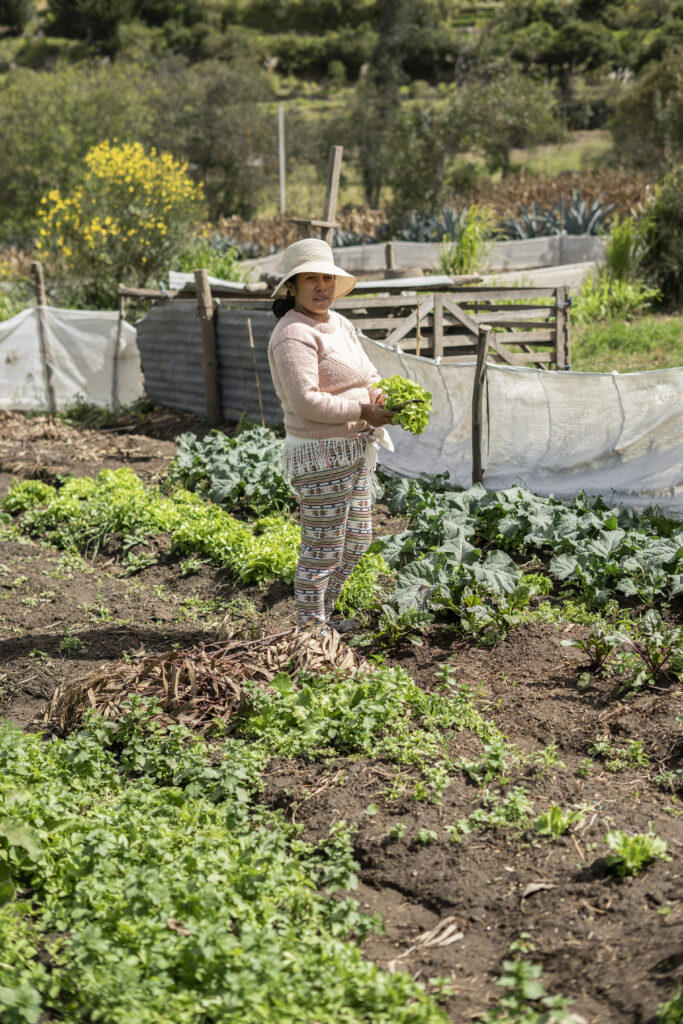
In Ecuador, Josselyn Vega is an Indigenous Kichwa Panzaleo farmer who is president of the Association of Agroecological Producers of Cotopaxi in the country’s highlands. Through her work and that of fellow farmers, she described how they were able to break out of an oppressive and largely hopeless hacienda-dominated ranching system, in which wealthy elites controlled the land and paid workers meager wages, and build the association that now comprises more than 120 women who are farming organic produce that they sell in formal markets.
Josselyn Vega harvests greens as part of an agroecological effort that connects women producers to local markets in Cotopaxi, Ecuador. Photo by Heifer International/Isadora Romero (2020).
Symbolic of the hurdles they had to clear, Josselyn described that when the women first tried to set up shop in the city food market, they were relegated to a poor space next to the market trash bins. Through the dynamic of meeting and spending time together, however, she and the other women farmers began to build their collective strength and assert themselves in a number of ways — including getting a better market space. “We are not alone anymore because when something happens to one of the women, it happens to all of us. And we have really felt the strength of talking out loud,” she said.
Their vivid stories and the conversations during the event attested to the innate capacities of these women to innovate workable solutions, persist in the face of daunting challenges, and practice inclusivity by bringing along others in their community on their transformational journeys. A few key points also came through in the discussion that can help inform those of us committed to supporting smallholders like Josselyn and Julian.
The Importance of Self-Esteem
Julian and Josselyn’s stories hinged on the ability to break through the preconceived notions of what a woman is and what she can realistically aspire to be in many societies. They related their experiences of being told from day one that they are not equal to a man in terms of work capabilities, social participation and educational potential. They assume this may be true and thus they don’t aspire to do much more than their mothers or grandmothers had done.
“When you are constantly told that you are less and you believe you are less, you start with very low self-esteem. That’s the first barrier that has to be broken for every woman farmer we work with,” said Neena Joshi, senior vice president for Asia programs at Heifer International.
It’s Not a Battle of the Sexes
They also asserted that improving the lot of women farmers is not a man-versus-woman proposition, much as it may be portrayed as such in discourses about the challenges women farmers face. Rather, the emphasis should be on framing women’s success as a plus for the family unit.
“I think that the work of including men [in solutions] starts from the family, that it’s actually more like a way to strengthen the family union,” said Josselyn. “We don’t need to see each other as super-women and that men aren’t learning anything. Men have also suffered discrimination and social exclusion, and it’s the same [social] system that makes them act the way they do,” she added.
Julian concurred, arguing that “the better families we have, the better communities and also the better country we will have.”
“The women now have voices, we can now work.” — Julian Nafula Simiyu
Making Farming an Attractive Option
Beyond gender dynamics, these women farmers have also succeeded in countering prevailing notions in their communities that farming is not a viable livelihood pursuit, regardless of whether you are a man or a woman. To get rural residents interested in committing to farming, they first need to see that it offers better livelihood options than what it has historically offered. Key to this is approaching farming as an entrepreneurial opportunity, not just a basic needs opportunity, and demonstrating through practice farming’s full potential.
“When I was growing up, people in the community would say ‘You should go to school and learn or you will just end up being a farmer.’ So I thought farming was just [a last resort] for people who have not attended school,” recounted Julian. “But now, if someone tells me to get a job somewhere else, I’ll stick to my farming and try to inspire other women to become farming entrepreneurs.”
How to Really Listen to Women Farmers
Circling back to our leading question about having farmers’ voices lead our programs and initiatives, Josselyn and Julian shared a few recommendations for all of us:
Know the territory — deeply. Listening is not just about people, it’s also about “listening” to where farmers live and knowing intimately the environment in which they operate. They equated it to like learning a language — there is the language but there is the culture, history and social dynamics which informs the language.
Catalyze women’s leadership skills. When women are primed to lead, they are more apt to make their voices heard. Thus, listening to farmers is also a question of supporting them in gaining the confidence to speak and express themselves.
Link grassroots listening to higher-level engagement. The role of support organizations should be not only to listen to farmers but help facilitate the insertion of these voices into government, business and other strategies that will contribute to sustainable, scalable change for women farmers.
Please be patient while we send you to a confirmation page.
We are unable to process your request. Please try again, or view common solutions on our help page. You can also contact our Donor Services team at 855.9HUNGER (855.948.6437).
-
includes to cover payment processing costs.
Give in Honor
You'll have the opportunity to fill out a free card after your donation
Details
,
Success!
Please be patient while we send you to a confirmation page.
We are unable to process your request. Please try again, or view common solutions on our help page. You can also contact our Donor Services team at 855.9HUNGER (855.948.6437).
Your Donation Amount
/mo
/yr
includes to cover payment processing costs.
Give in Honor
You'll have the opportunity to fill out a free card after your donation