Lantana Abubakar holds a small bundle of rice while standing in her field in Nigeria. Photo by Heifer International/Phillip Davis.
More than 10 years after the International Year of Family Farming in 2014, the world finally has an opportunity to recognize the fundamental role that women play in rural households with the International Year of the Woman Farmer in 2026.
Recognizing women’s contributions, however, is only the first step; removing the barriers and prejudices they face must come next because gender inequality within agriculture continues to feed poverty and food insecurity across developing countries.
A Major Workforce With Limited Resources
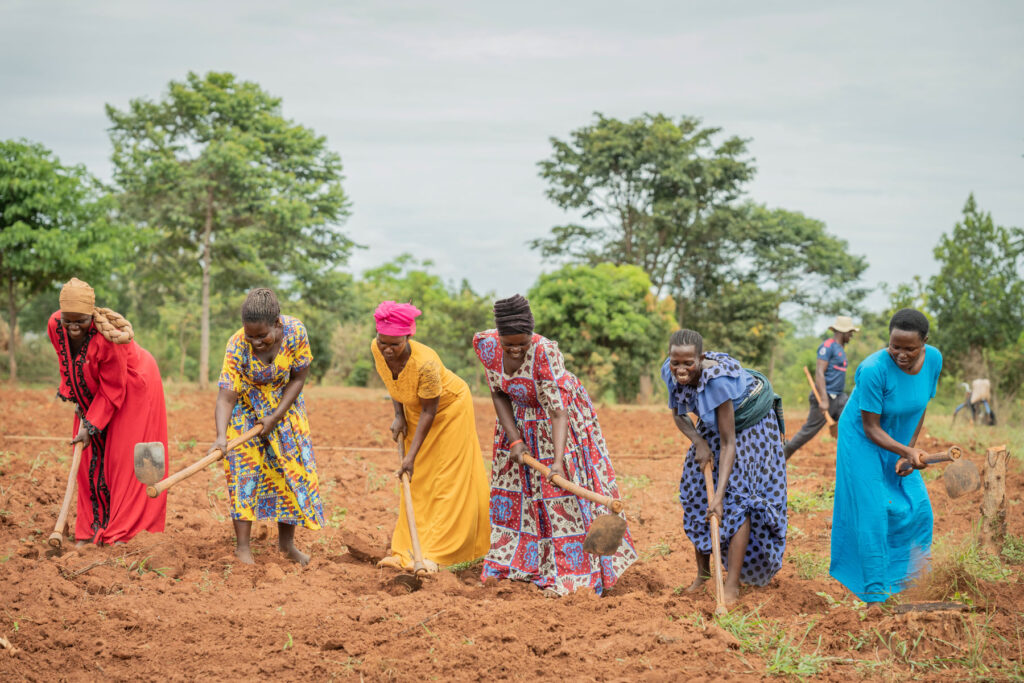
Women members prepare land for soybean planting in the town of Nankoma, Eastern Uganda. Photo by Heifer International/Muhumuza Joseph.
While around a third of women worldwide earn a living from agriculture, women make up nearly half of the agricultural workforce in sub-Saharan Africa. They are responsible for up to 80 percent of food production in low- and middle-income countries. Yet they own less than 15 percent of agricultural land and receive less than 10 percent of agricultural loans, which hampers their ability to invest in irrigation, improved seeds, more livestock and other tools and resources that could increase their yields.
Even when they shoulder most of the farm workload, women are often excluded from decision-making, formal markets and co-ops, losing out on better prices, training and market intelligence.
Closing the Gender Gap to End Hunger
To create lasting change that would drive progress toward sustainable development and reduce global hunger, governments, funders, NGOs and companies must work together to remove the barriers that prevent women farmers from reaching their full potential. Closing this gender gap is not only a matter of fairness to women; it would also feed millions more people and strengthen food security worldwide.
Research shows that women are just as efficient as men when they have the same access to resources. According to estimates from the UN Food and Agriculture Organization, giving women equal access to productive resources could increase farm yields by up to 30 percent, reducing the number of hungry people in the world by up to 17 percent.
Improving women’s access to training and technology sets off a multiplier effect that transforms entire communities. With equal access to resources, women farmers could grow, process and sell more food, which could help lift 150 million people out of food insecurity.
These gains would ripple outward because women typically reinvest up to 90 percent of their income in family welfare, culminating in better nutrition, education and health outcomes for children and the communities at large.
Evidence From the Field
Evidence from Heifer International’s work across Asia, Africa and the Americas shows how quickly progress can be achieved when women farmers gain equal access to resources.
In Rwanda, with support from Heifer International, rural women formed a savings group that began with just 20 cents each per week. Their pooled savings grew into a small chicken feed business, and with further training, they established a livestock farmer field school that helped members improve animal husbandry practices and double their milk production.
Similarly, in Mexico and Bangladesh, Indigenous women farmers have significantly increased their family incomes through training, cooperative support and direct links to formal markets. Their success reflects a pattern we see across continents: when women farmers gain skills and market access, their enterprises grow, their families thrive and their communities benefit.
Women Farmers Leading Climate-Smart Agriculture in Bangladesh
Mosammat Laboni Khatun harvests cabbages from her farm in Bijoy Nagar village, Bangladesh. Photo by Heifer International/Russell Powell.
With a population of 176 million, Bangladesh is one of the most densely populated countries in the world. It is also among the countries most vulnerable to climate change, with women farmers often hit the hardest by impacts such as cyclones and floods.
Mosammat Laboni Khatun, a 30-year-old farmer from the Jashore district, has transformed her one-bigha (about one-third of an acre) plot into a thriving market garden through collective support from Heifer Bangladesh’s Women Farmers Grow Vegetables, Flowers and Wealth project.
Gaining access to training and resources that allow her and other women farmers to steward sustainable agriculture, Laboni uses raised beds to prevent waterlogging on her farm. She also uses organic fertilizer made from cow dung and kitchen waste to improve her crop growth, which saves her money and allows her to produce vegetables without chemicals.
Before joining the project, Laboni earned about 70,000 taka (about $574) per season. Today, she earns roughly 110,000 taka (about $902) and leases additional land using her increased income. As part of a women’s cooperative, she also sells produce collectively, gaining better prices and market linkages, and teaches other women the same techniques.
To date, the Women Farmers Grow Vegetables, Flowers and Wealth project has trained more than 5,600 Bangladeshi women farmers on climate-smart agricultural techniques, including new crop varieties and mulching. Cooperatives supported by the project have adopted eight solar-powered irrigation pumps, using less diesel fuel and cumulatively reducing carbon emissions by nearly 33,000 liters of carbon dioxide per month.
Challenging Restrictive Norms in Mexico
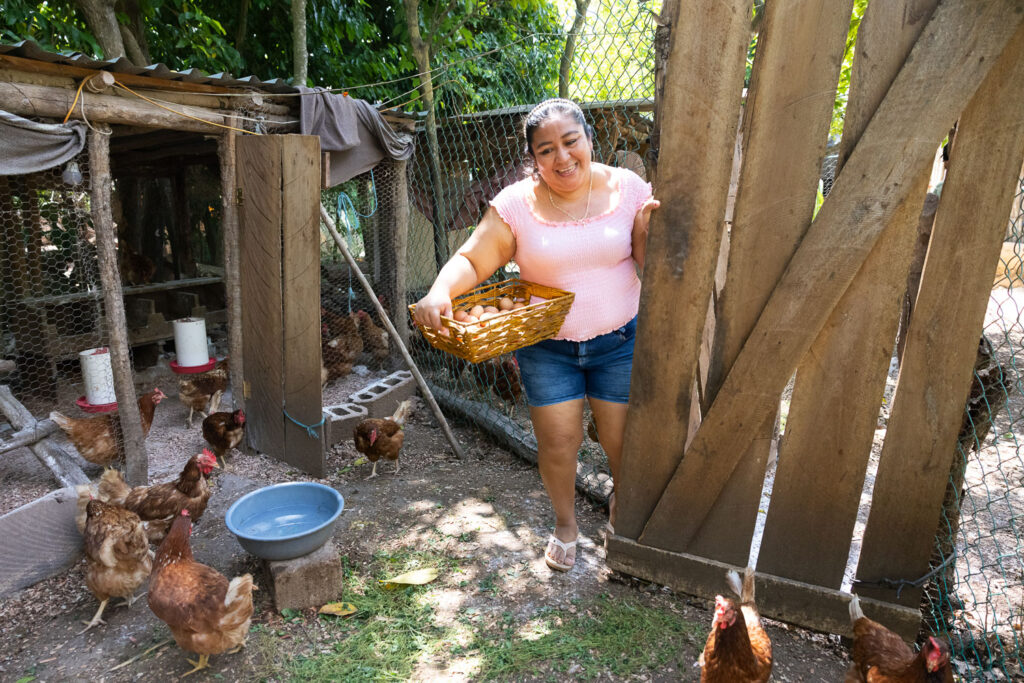
Marbella Cab Ku collects eggs from her chickens as part of the Kikibá cage-free egg enterprise in Yucatán, Mexico. Photo by Heifer International/Nicole Franco.
In Mexico, the lack of income, land title and investment leaves many women vulnerable, with little to no economic power and minimal participation in household decisions.
Through Heifer Mexico’s establishment of the Kikibá collective in 2020, 37-year-old Lidia Maribel Moo Poot and several other women are building a thriving cage-free egg enterprise that is improving livelihoods and challenging long-held beliefs about women’s roles across communities.
Each member of the collective received 50 hens, along with training in sustainable poultry rearing, business development and food safety. Kikibá, which means “very, very delicious,” now supplies restaurants and shops across Quintana Roo and Yucatán. In Bacalar alone, the collective sells up to 90 crates of eggs a week.
“Being a woman is not a limiting factor … many things can be achieved, as women,” says Lidia, who now manages sales for her chapter and mentors others.
The collective’s members’ income has grown significantly, now contributing an average of 12 percent of household earnings, while their participation in financial decisions has risen from 66 percent to 100 percent.
As demonstrated in Bangladesh, Mexico and elsewhere, the world can make progress toward zero hunger when we begin to give women farmers the tools, resources and recognition that they deserve. And 2026, the International Year of the Woman Farmer, is a moment to redouble efforts to close the gender gap in agriculture for the benefit of all.
Every day, women farmers make invaluable contributions to agriculture — and with support to overcome the unique challenges they face, they are catalysts for social and economic change.
Please be patient while we send you to a confirmation page.
We are unable to process your request. Please try again, or view common solutions on our help page. You can also contact our Donor Services team at 855.9HUNGER (855.948.6437).
-
includes to cover payment processing costs.
Give in Honor
You'll have the opportunity to fill out a free card after your donation
Details
,
Success!
Please be patient while we send you to a confirmation page.
We are unable to process your request. Please try again, or view common solutions on our help page. You can also contact our Donor Services team at 855.9HUNGER (855.948.6437).
Your Donation Amount
/mo
/yr
includes to cover payment processing costs.
Give in Honor
You'll have the opportunity to fill out a free card after your donation