Chin Tola holds freshly collected eggs inside her poultry house in Kampong Thom province, Cambodia. Photo by Heifer International/Sophea Uth.
As the world marks the International Year of the Woman Farmer, the story of Chin Tola from Cambodia’s Kampong Thom province reminds us that when women farmers are equipped with knowledge, skills and collective support, they become drivers of resilient food systems and rural transformation.
Across Cambodia, backyard chickens help families put food on the table, earn extra income and weather unexpected financial challenges. Yet for many smallholder farmers, especially women, raising healthy flocks remains difficult. Limited access to technical training, animal health services and reliable markets leaves even experienced farmers vulnerable to disease, financial losses and unstable incomes.
Through Heifer International’s Poultry Project of National Pride in Cambodia, farmers receive specialized training, including guidance on poultry health and flock management, along with access to capital and stronger market connections to build profitable poultry businesses. For Tola, those opportunities became the foundation for her journey from struggling chicken producer to respected trainer and cooperative leader.
Like many women farmers across Cambodia, Tola began relying on traditional chicken-rearing practices passed down through generations. While rooted in local knowledge, these methods offered limited protection against disease. “I did not have the technical knowledge to care for my chickens properly, and my flock often suffered from infectious diseases,” she said.
Her turning point came in 2018, when she joined a self-help group through a cooperative supported by Heifer International Cambodia. For Tola, this was more than an opportunity to improve production; it was an entry point into learning, leadership and collective action. Through targeted training provided by Heifer International Cambodia in poultry health, disease prevention and flock management, she began transitioning from subsistence-oriented practices to a knowledge-based, market-driven farming model.
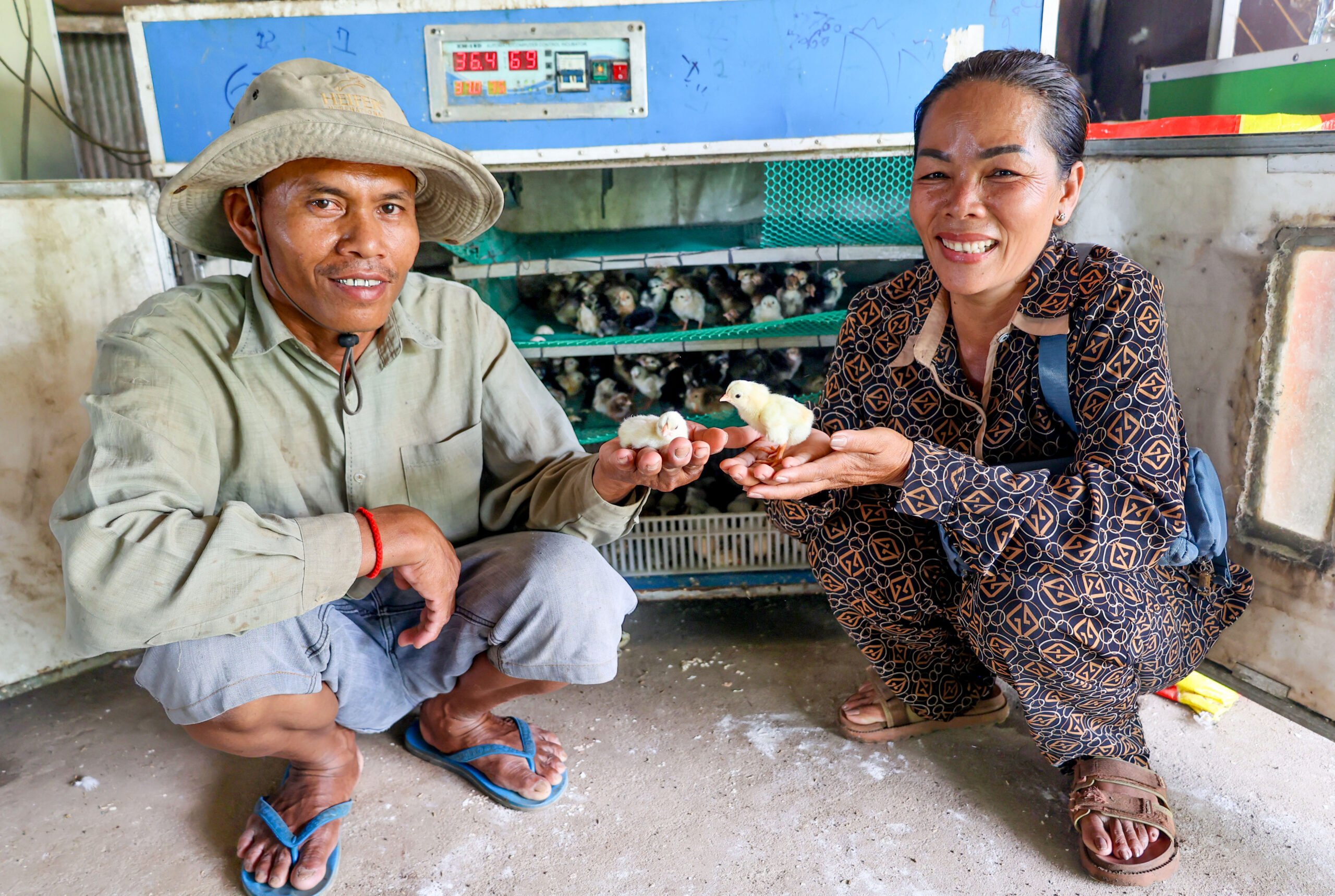
Chin Tola, right, holds a newly hatched chick in front of an incubator in Kampong Thom province, Cambodia. Photo by Heifer International/Sophea Uth.
“The training changed everything,” Tola said. “Since gaining knowledge from the project, my chickens have remained free from diseases.” She adopted improved practices such as systematic vaccination against fowl cholera, Newcastle disease and Gumboro disease, along with timely booster doses. She also improved feed quality by providing vitamin-rich supplements and integrating fodder grass and Azolla, a nutrient-rich aquatic plant, into her chickens’ diet. Together, these practices significantly improved productivity and resilience.
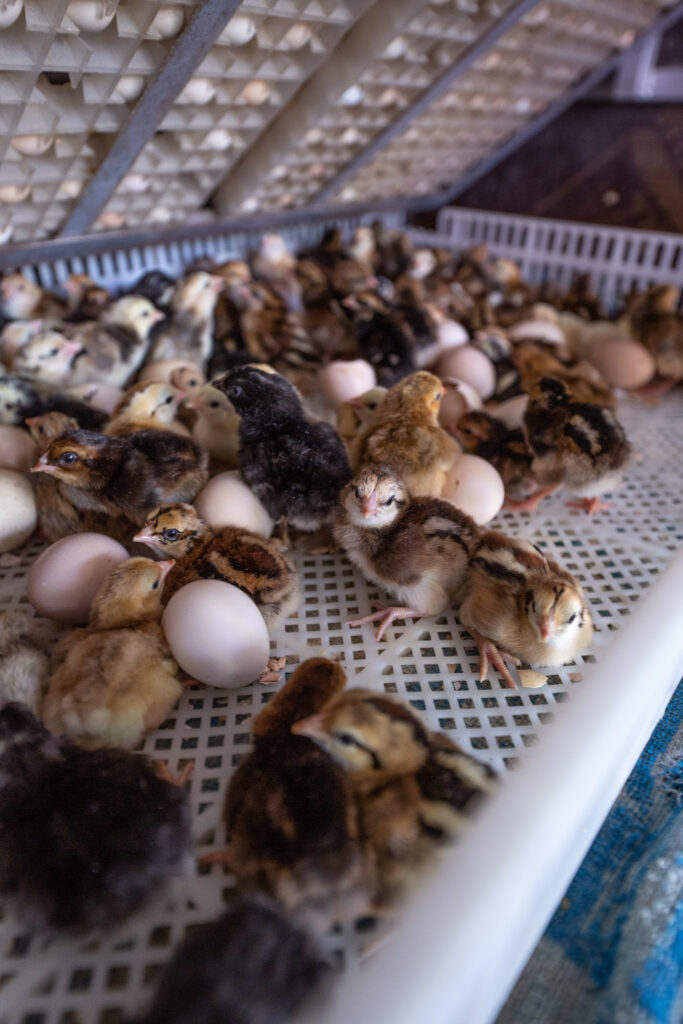
Newly hatched chicks rest in an incubator at a modern chick hatchery enterprise, one of the key infrastructure investments of the Poultry Project of National Pride in Cambodia. Photo by Heifer International/Phillip Davis.
Today, Tola manages a thriving flock of 200 parent stock chickens and sells approximately 1,200 chicks every month to fellow cooperative members. Before joining the cooperative, she earned no income from poultry and relied on rice farming alone. Her monthly income now ranges from $250 to $1,000 in chick sales, with an additional $500 from fattening chickens. This financial stability has enabled her to provide for her family and invest in her child’s education.
Tola’s impact extends far beyond her own farm. After receiving training from Heifer International Cambodia, she became a local poultry trainer, passing along the same knowledge that helped transform her own business. She regularly trains fellow cooperative members, sharing practical guidance on disease prevention and sustainable native chicken production. “I teach farmers how to raise chickens in a way that keeps them healthy and productive,” she said. So far, she has trained approximately 120 cooperative members. In doing so, she has become a trusted resource in her community, strengthening local capacity and collective resilience.
Looking ahead, Tola plans to expand her parent stock from 200 to 500 chickens — a goal that reflects her growing confidence as a poultry farmer, business owner and community leader.
About Heifer’s Work in Cambodia
Through the Poultry Project of National Pride in Cambodia, Heifer International works with cooperatives and rural communities to strengthen Cambodia’s poultry sector. By expanding access to technical training, market opportunities and modern poultry infrastructure, the project helps smallholder farmers raise healthier flocks, grow profitable poultry businesses and build more secure livelihoods. The project reaches communities across 11 provinces.
Trained in self-help group manangement, poultry production, leadership development and the 12 Cornerstones by Heifer, Set Hach is now a thriving chick producer and a leader in her community.
Please be patient while we send you to a confirmation page.
We are unable to process your request. Please try again, or view common solutions on our help page. You can also contact our Donor Services team at 855.9HUNGER (855.948.6437).
-
includes to cover payment processing costs.
Give in Honor
You'll have the opportunity to fill out a free card after your donation
Details
,
Success!
Please be patient while we send you to a confirmation page.
We are unable to process your request. Please try again, or view common solutions on our help page. You can also contact our Donor Services team at 855.9HUNGER (855.948.6437).
Your Donation Amount
/mo
/yr
includes to cover payment processing costs.
Give in Honor
You'll have the opportunity to fill out a free card after your donation