Damyanti Pangi tends coffee on her family farm in Odisha, where her household also grows turmeric and other crops. Heifer International/Phillip Davis.
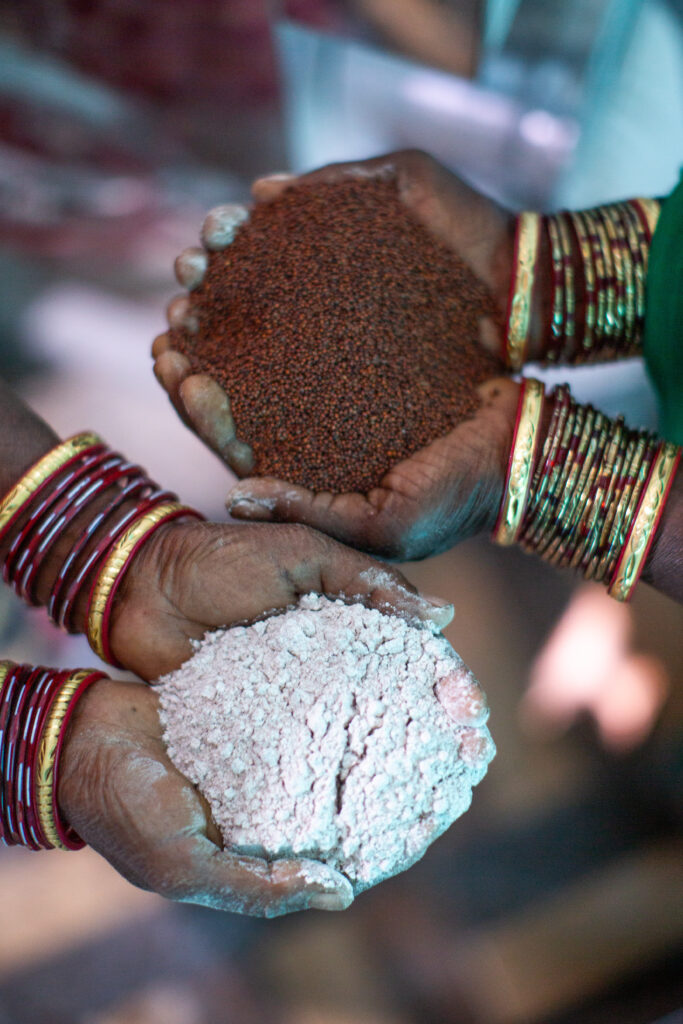
Women farmers hold cleaned millet and millet flour in Odisha, India. Damyanti recalls surviving on porridge made from millet flour when work was scarce. Photo by Heifer International/Phillip Davis.
Damyanti Pangi’s sons bring her apples — a treat to honor her hard work on their family farm in Khudub village, located in the state of Odisha, India. Her agriculture business has made these small luxuries possible, allowing her to expand her family’s vegetarian diet to include mushrooms, paneer, dahl, cabbage, leafy green vegetables and bananas. But this abundance wasn’t always available.
Growing up, having little or nothing to eat was the norm in Damyanti’s family. “We used to get rice in exchange for work. Only this much,” she said, cupping her hands to illustrate.
When work was scarce, as it frequently was, the family sustained themselves on porridge made from millet powder.
At 17, Damyanti married her husband, Kamaya. They shared a one-room mud-and-thatch home with his parents. At that time, they owned only enough land to grow a small plot of millet, just enough for the household. To get by, they worked on neighboring farms, saving as much money as they could to eventually lease more land.
Five years later, Damyanti and Kamaya began cultivating turmeric and later added potatoes to their fields. As their income gradually increased, they began building a stone-and-cement home of their own, working on it one room at a time in stops and starts, when money allowed. It took more than a decade to complete.
A Collective Source for Entrepreneurial Support
Three years ago, Damyanti became a member of the Alekh Mahima Farmers Producer Company, a women-led farmer producer organization (FPO). The FPO is supported through the Women Entrepreneurs for Women Entrepreneurs (WE4WE) initiative, facilitated by Passing Gifts Private Limited. Passing Gifts is an Indian organization that facilitates work aligned with Heifer International’s mission to help smallholder farmers improve food security and access economic opportunities.
As a member of the Alekh Mahima Farmers Producer Company, Damyanti gained access to training, markets and financing. Convinced she could receive a better price for her harvest, she decided to sell her turmeric through the FPO rather than navigate the market alone.
“We have the produce, but we don’t know whom to sell to, so Passing Gifts helped us to get connected with a proper vendor or company,” Damyanti explained.
Today, the family of five owns an acre of land, leases an additional acre, and lives in a comfortable four-room house. Damyanti’s eldest son, Shankar, 32, lives with his wife, while her three younger boys — Trinath, 27, Kesab, 23, and Himanshu, 18 — live with her and Kamaya.
The Transformative Impact of Economic Opportunity
By joining Alekh Mahima, Damyanti also gained access to life-changing equipment.
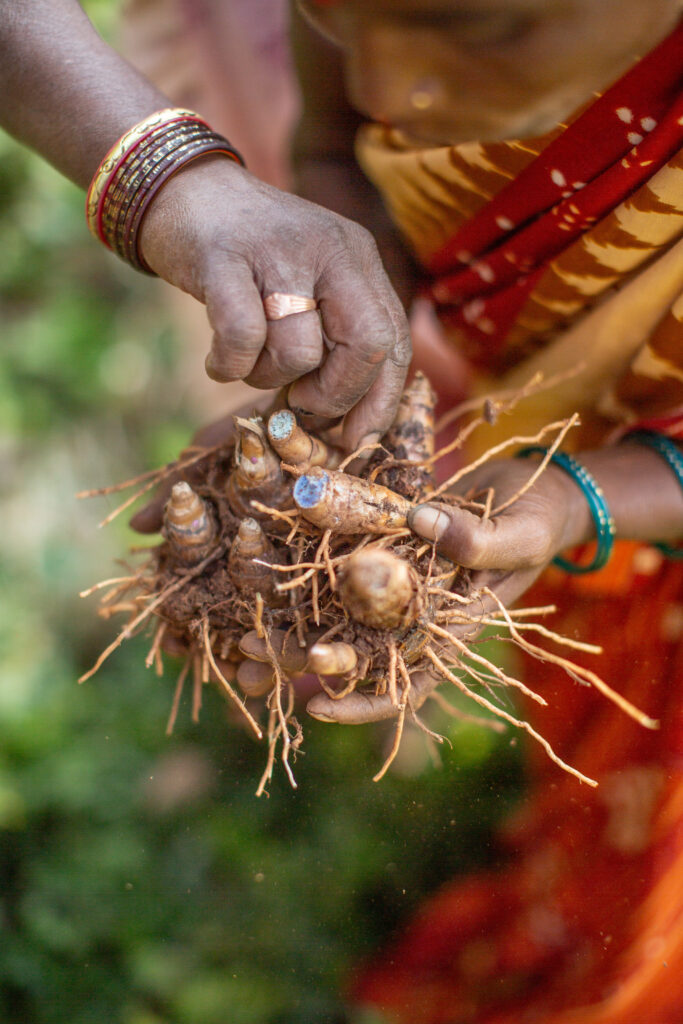
Processing turmeric used to be a time-consuming ordeal. Damyanti spent more than a week boiling just five bags of turmeric in a pot on her kitchen stove. Because it was so labor-intensive, she often had to sell some of her harvest dry or raw just to keep income coming in. She earned just 5 rupees (about 6 cents) per kilogram for raw turmeric and 20 rupees (about 22 cents) for processed turmeric.
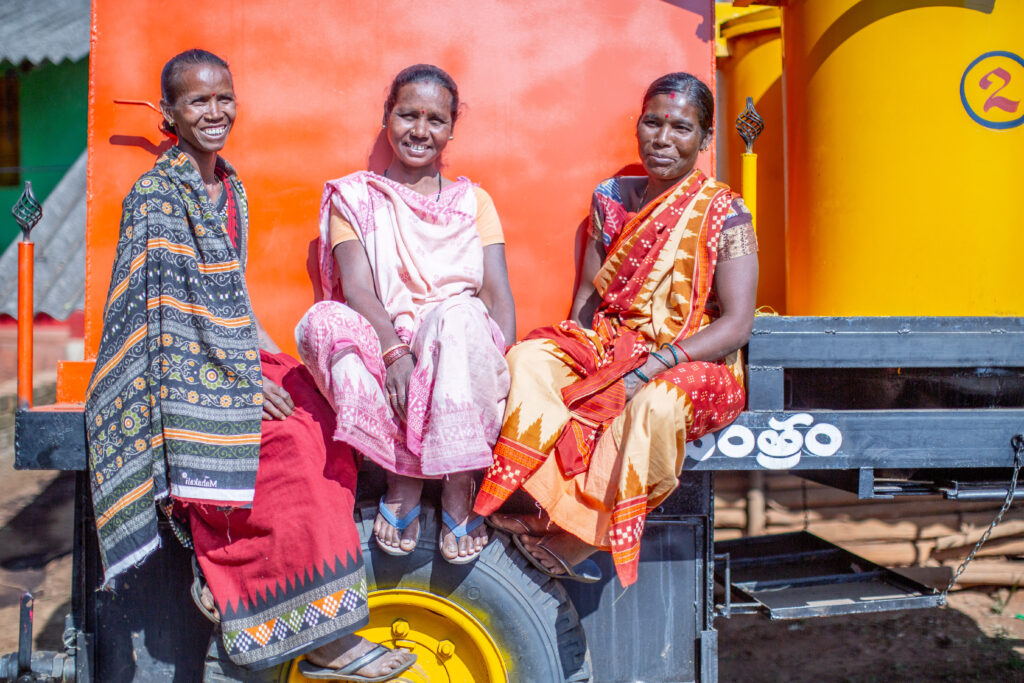
Not anymore. Damyanti beams as she sits in front of her village’s new 1,000-liter (264-gallon) water tank and two massive, bright yellow steam drums. “We used to cry a lot because of hunger,” she said. “Now, we laugh because we are happy.”
Passing Gifts helped the FPO acquire the water tank, steam drums and a specialized polisher and facilitated training on how to use the equipment affordably. With these new tools, Damyanti can process the exact same amount of turmeric — which used to take a week — in about an hour.
Left to right, Janaki Pangi, Damyanti Pangi and Sumitra Pangi sit on a turmeric-processing machine in Odisha, India. Photo by Heifer International/Phillip Davis.
Damyanti pays a fee of 50 rupees (about 55 cents) per 100 kilograms (220 pounds) to use the machinery. She sells her processed turmeric to Alekh Mahima for 120 rupees (about $1.33) per kilogram (2.2 pounds). That’s a staggering sixfold increase over her previous processed price.
Through Alekh Mahima, Damyanti also learned how to plant rice and millet in straight rows by using a string to measure the proper distance between each plant. Previously, she scattered the rice and millet seeds and weeded her plots by hand.
“Now we keep the proper distance, so we can use a machine to remove all the weeds in one go,” she said.
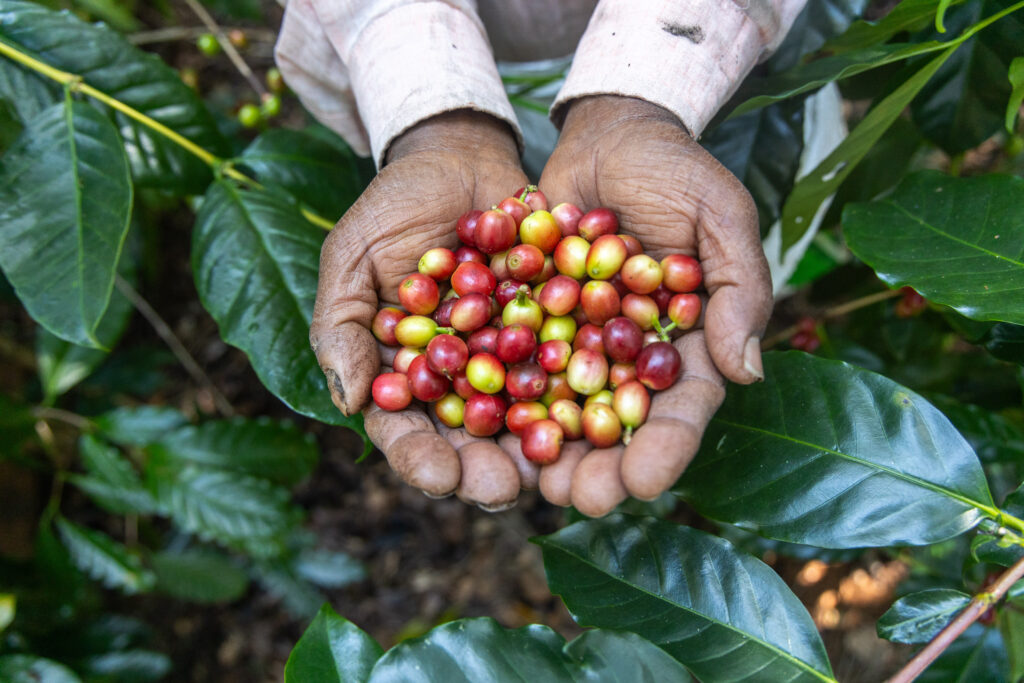
With her increased efficiency and production, Damyanti now has more time and money to invest in her household and community. In addition to turmeric and potatoes, she grows coffee, ginger, rice, millet, tomatoes, chili and flat beans.
Freshly harvested coffee cherries from Damyanti Pangi’s family farm in Odisha, India. Photo by Heifer International/Phillip Davis.
“Earlier, we had no idea we can use manure in a larger farm area,” she said. “It was very difficult, so we never used to do it.
“After getting proper training, we learned how to prepare manure, and now we use it, and the quality of our produce has increased,” Damyanti said.
She recently expanded her business again to include rare and valuable black turmeric, using specialized seeds provided by a government high-altitude crop research entity and facilitated by Passing Gifts.
Diversifying her crops and earning fairer prices has dramatically increased her family’s income. In the past, they earned about 50,000 to 60,000 rupees (about $550 to $661) each year from farming. Today, Damyanti estimates they earn about 200,000 rupees (about $2,203) annually — roughly four times as much.
Empowering Women Farmers to Thrive on Their Own Terms
Harvested turmeric roots illustrate how women farmers in Odisha earn more through value-added processing. Photo by Heifer International/Phillip Davis.
Through the Women Entrepreneurs for Women Entrepreneurs (WE4WE) initiative, women farmers in Odisha gain greater access to financing, training and potential supply chain partners. In Odisha’s Koraput District, where Damyanti lives, women contribute the majority of agricultural labor yet remain severely underrepresented in decision-making. Initiatives like WE4WE help address those barriers by connecting women farmers with the resources and relationships they need to strengthen their businesses.
When women farmers organize into FPOs, their collective voice becomes stronger, and they gain crucial leverage to bypass exploitative middlemen. By working together rather than as isolated laborers, they generate more profit for themselves and their communities.
A More Sustainable Future for All
For Damyanti, financial freedom is building a path to generational change. She is using her increased income to pay for her youngest son’s private college education — a meaningful milestone for a mother who never had the chance to attend school herself. She is also saving to build an additional home for her growing family.
When women farmers have access to the right resources and support, they build businesses that change what’s possible for their families and communities. By nurturing women’s personal agency and business acumen, initiatives like WE4WE create inclusive, profitable and ecologically resilient food systems and life-changing generational impact.
The Weight of Opportunity: Women Farmers Strengthen Markets Together in Odisha
By Heifer International|May 28, 2026
Women in rural Odisha who once had little influence over pricing or household decisions are now shaping markets, leading cooperatives and helping other women succeed.
Please be patient while we send you to a confirmation page.
We are unable to process your request. Please try again, or view common solutions on our help page. You can also contact our Donor Services team at 855.9HUNGER (855.948.6437).
-
includes to cover payment processing costs.
Give in Honor
You'll have the opportunity to fill out a free card after your donation
Details
,
Success!
Please be patient while we send you to a confirmation page.
We are unable to process your request. Please try again, or view common solutions on our help page. You can also contact our Donor Services team at 855.9HUNGER (855.948.6437).
Your Donation Amount
/mo
/yr
includes to cover payment processing costs.
Give in Honor
You'll have the opportunity to fill out a free card after your donation