Glendi Mercedes Teyul tends to cacao beans as they dry in Pinares, Alta Verapaz, Guatemala. Photo by Heifer International/Delfa Zamora.
There was a time when 28-year-old Glendi Mercedes Teyul arrived at community meetings convinced that the best thing for her to do was listen. She remained silent while others spoke, even though she knew the work of the land and had accompanied her father in cacao cultivation since she was a child.
Today, the exact opposite is true. Producers seek her out for her advice on managing plots, to learn new techniques or to discover how to transform cacao into artisanal chocolate. The young woman who once avoided speaking in front of a group is now one of the most respected leaders in her community of Pinares, a village in the mountains of Alta Verapaz, Guatemala.
“Before, I was embarrassed to speak in public and participate in meetings. Now I like to share what I know and help other people,” she said with a smile.
That change didn’t happen overnight. Glendi’s confidence grew as she participated in training sessions on leadership and gender equality offered by Heifer International Guatemala. Other technical and community-focused training followed. More than learning new concepts, Glendi discovered something she hadn’t recognized in herself until then: that her voice also had value and she could contribute to her community’s development.
Little by little, she gained confidence. Then came courses on cacao management, grafting, agroforestry systems, shade management and community organization. Each lesson opened a new door. Glendi became deeply involved with the Association of Indigenous People for the Integral Productive Development of the Pinares Village (APIDIP), where she now serves as treasurer. She also serves as a community promoter and shares what she has learned with other farmers.
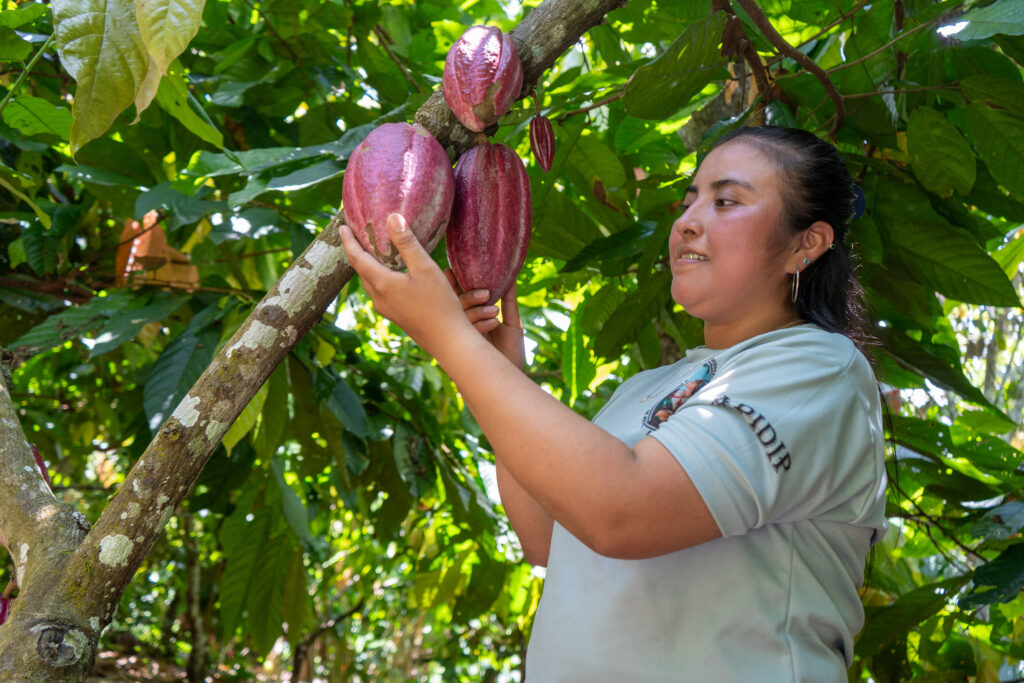
Glendi examines cacao pods growing on a tree in her community of Pinares. Photo by Heifer International/Delfa Zamora.
A Learning Experience That Began to Multiply
In addition to her other roles, Glendi coordinates a group of 25 women who make chocolate. The women already knew how to transform cacao into chocolate, but through Glendi’s role as a community promoter, she brought back lessons on value addition and collective marketing. Heifer and APIDIP also worked with the group to strengthen its organization and explore marketing strategies, partnerships and opportunities for their chocolate to reach new markets.
But Glendi knows that the most important thing isn’t the chocolate; what’s truly valuable is seeing how women who once doubted themselves now participate, share their opinions, make decisions and discover that they, too, can be entrepreneurs. “What I enjoy most is supporting people and sharing what I’ve learned,” she said. And that knowledge has begun to bear fruit.
Some members of the group sell chocolate to neighbors and family. These steps are small but significant. Each chocolate bar sold represents additional income for the women’s households and, above all, an opportunity to put what they have learned into practice.
“Before, I was embarrassed to speak in public and participate in meetings. Now I like to share what I know and help other people.”
— Glendi Teyul
Earning the Trust of an Entire Community
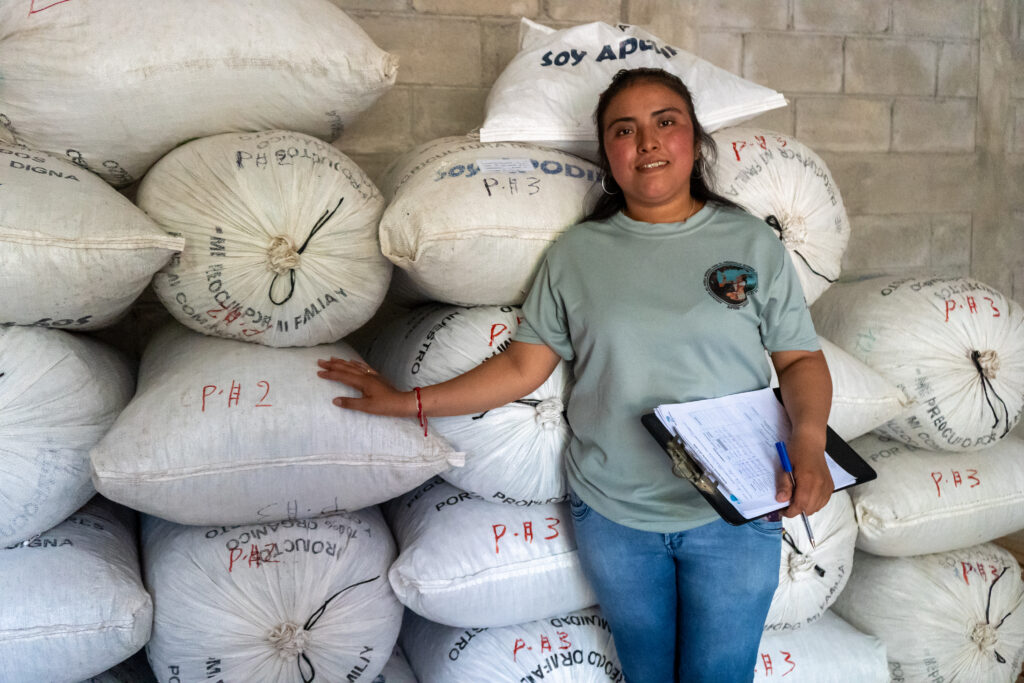
Glendi stands among sacks of cacao at APIDIP’s facilities in Pinares, Alta Verapaz, Guatemala. Photo by Heifer International/Delfa Zamora.
Glendi’s leadership has also become visible in the cacao fields. As a community promoter, she shares grafting techniques, crop management and good agricultural practices. At first, it wasn’t easy. In an environment where men historically occupied those spaces, Glendi needed patience and perseverance to make herself heard.
Today, no one in the community is surprised to see Glendi lead a training session. On the contrary, men and women seek her guidance because they know she shares what she has learned with simplicity and generosity. That recognition is one of the achievements she values most.
“I feel proud when I see the results of my work. Before, I was afraid to lead a group; now I enjoy teaching and seeing others put what they’ve learned into practice,” she said.
When an Opportunity Changes Many Lives
Glendi’s story is both a personal success and a reflection of what can happen when communities receive sustained support. In June 2025, Glendi was selected as a community promoter through a cacao project implemented by Heifer International Guatemala in partnership with the Food and Agriculture Organization.
The project supports climate adaptation and resilient cacao agroforestry systems, with an emphasis on approaches that are gender-inclusive and culturally relevant. Through the project, Glendi participated in 10 workshops and received ongoing technical support in the field, strengthening her technical knowledge and leadership skills. She then shared what she learned in the Mayan language of Q’eqchi’ with 152 farmers in Pinares.
In Glendi’s case, the impact of the training she received went far beyond the personal: What she learned became shared knowledge, supporting women who make and sell chocolate, families working to improve their crop management and a community that is beginning to recognize women’s leadership as a strength, not an exception.
“I feel proud when I see the results of my work.”
— Glendi Teyul
Looking Further
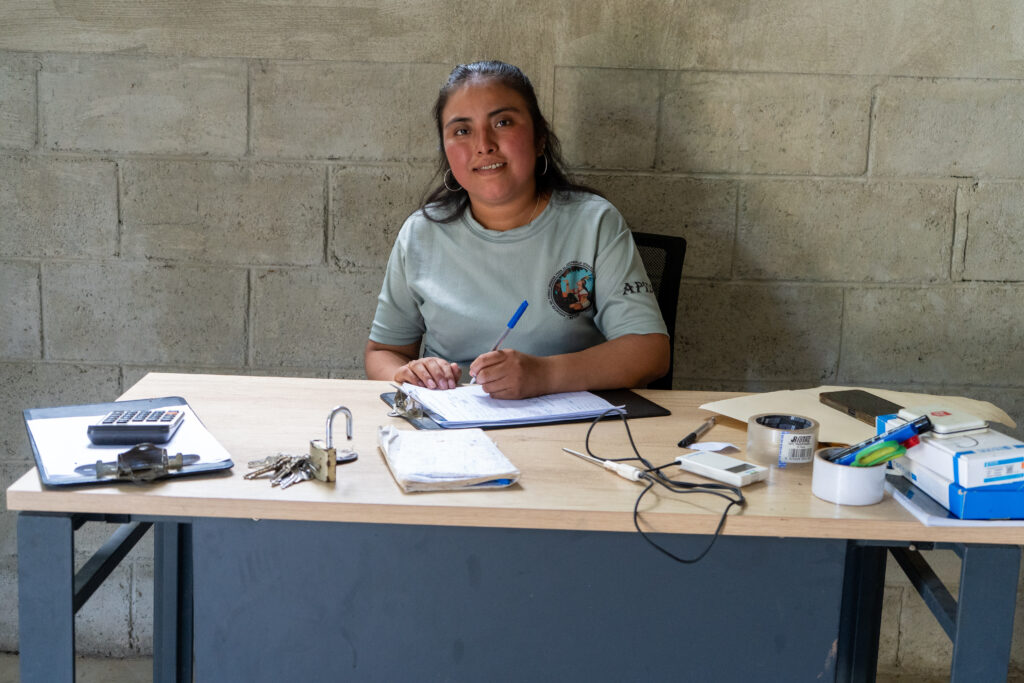
Glendi reviews paperwork at APIDIP in Pinares, Guatemala. Photo by Heifer International/Delfa Zamora.
When Glendi talks about the future, she doesn’t just think about herself. While APIDIP has facilities for fermenting, drying and storing cacao to help producers improve quality and prepare their crops for market, Glendi dreams of taking that work further with a small chocolate factory that could add more value to the cacao produced by families in the community. She envisions new markets, more job opportunities and better incomes for women and young people.
She also wants to continue training other women because she knows, from her own experience, that just one opportunity is enough to change the course of a life. Her opportunity began the day she decided to overcome her fear of raising her hand in a meeting and speaking up.
Today, her voice inspires other women to discover their own, strengthens farming families and demonstrates that rural development is also built when a woman finds the confidence to lead. And perhaps that is the most important transformation of all.
Every day, women farmers make invaluable contributions to agriculture — and with support to overcome the unique challenges they face, they are catalysts for social and economic change.
Please be patient while we send you to a confirmation page.
We are unable to process your request. Please try again, or view common solutions on our help page. You can also contact our Donor Services team at 855.9HUNGER (855.948.6437).
-
includes to cover payment processing costs.
Give in Honor
You'll have the opportunity to fill out a free card after your donation
Details
,
Success!
Please be patient while we send you to a confirmation page.
We are unable to process your request. Please try again, or view common solutions on our help page. You can also contact our Donor Services team at 855.9HUNGER (855.948.6437).
Your Donation Amount
/mo
/yr
includes to cover payment processing costs.
Give in Honor
You'll have the opportunity to fill out a free card after your donation