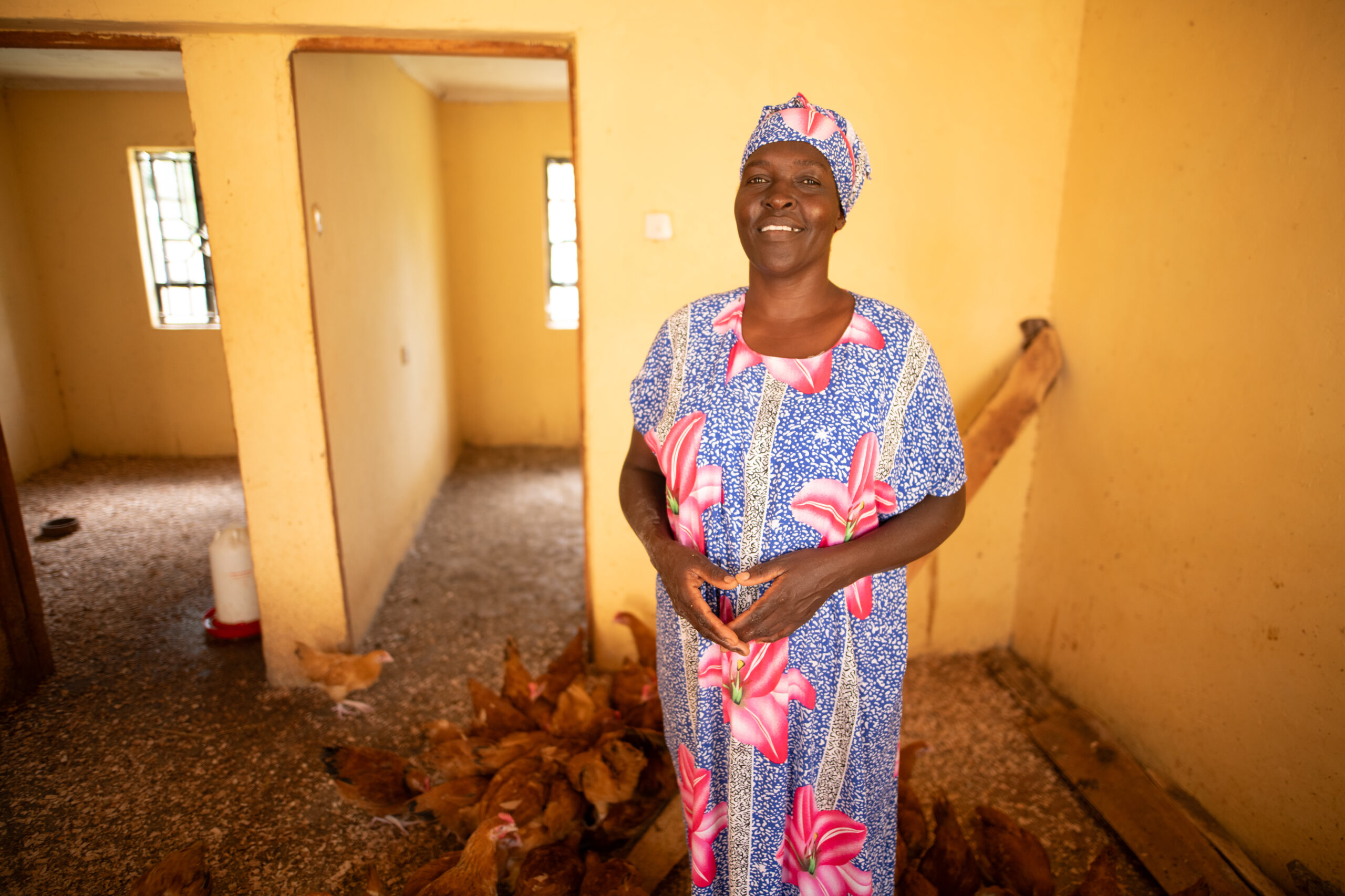
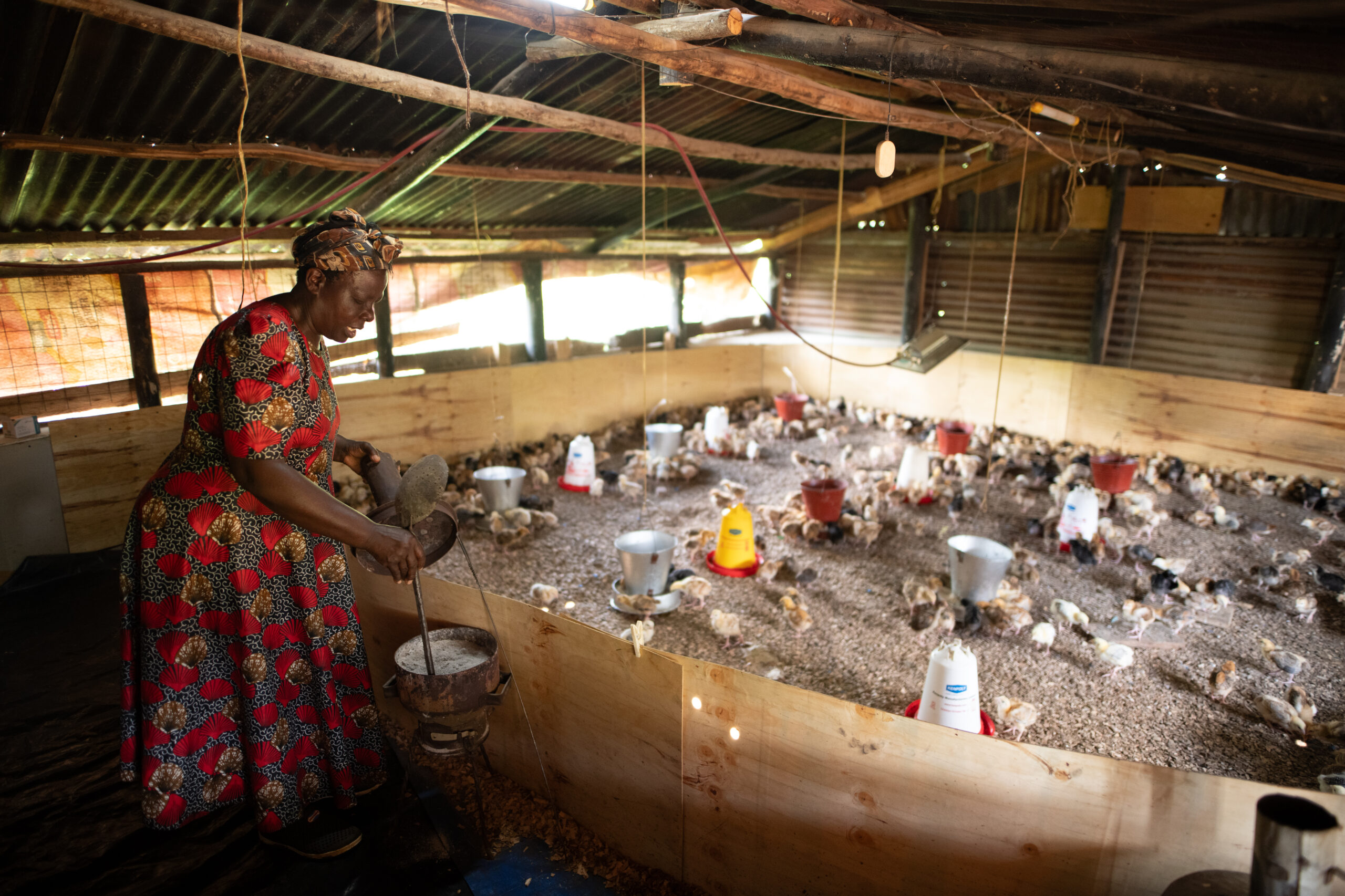
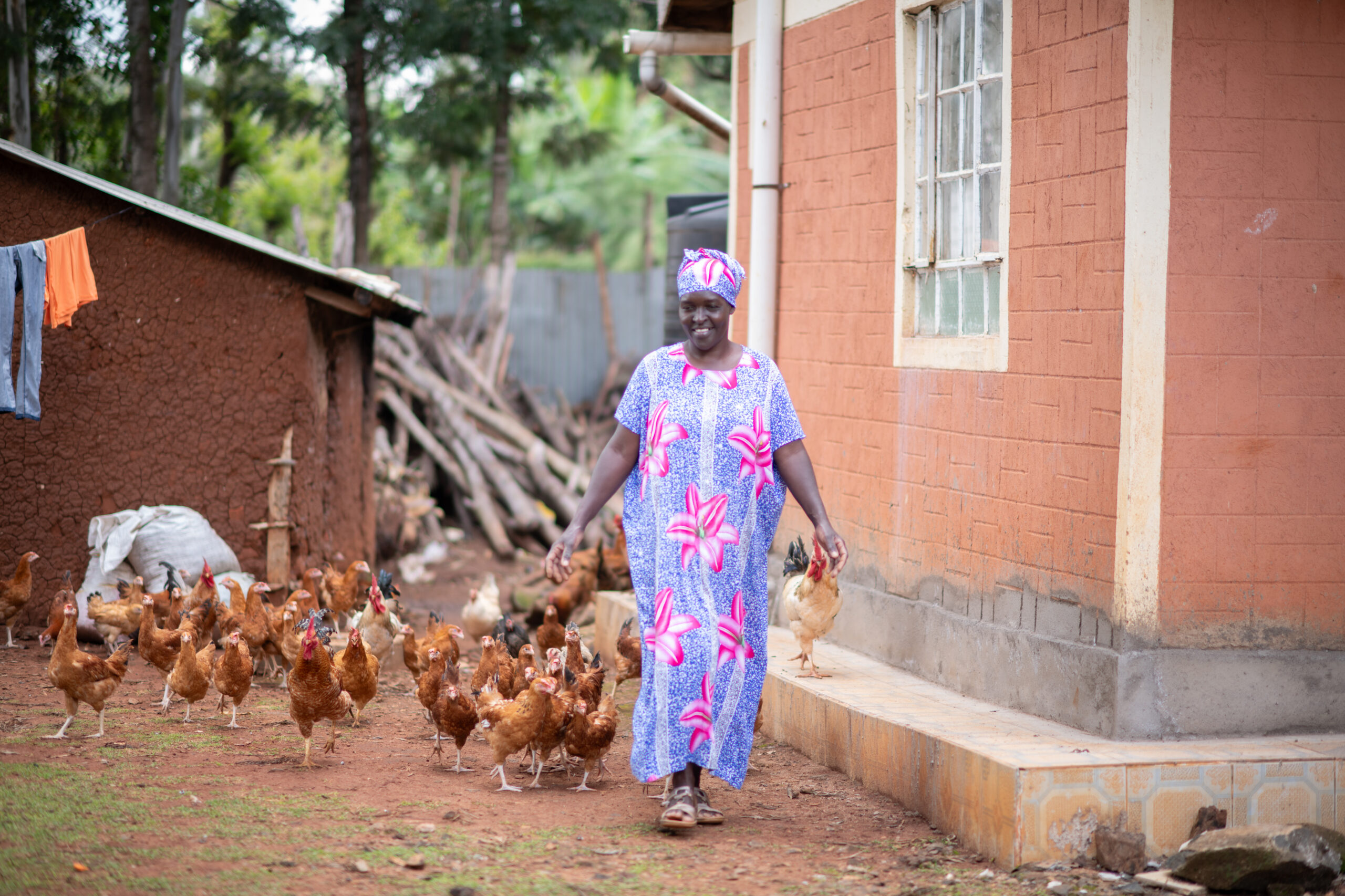
Eunice Asenah, a poultry farmer from the Kukubora Poultry Farmers’ Group, feeds her eight-week-old chicks at her homestead farm in Kongoni, Kakamega, Western Kenya. Heifer International/Allan Gichigi
In the lush, green highlands of western Kenya, members of the Kukubora Poultry Farmers Group gather beneath the generous shade of a mango tree. The 60-member-strong cooperative meets here regularly to discuss the challenges of smallholder poultry farming and their efforts, as a cooperative, to support one another. In rural Kenya, poultry and other livestock are key to creating healthy local economies, yet millions of small-scale livestock farmers, including Kukubora’s members, struggle to earn a living income.
“Some members even came to the group without shoes [and] their children had dropped out of school because of fees.”
–Gertrude Abuti, cooperative chairwoman
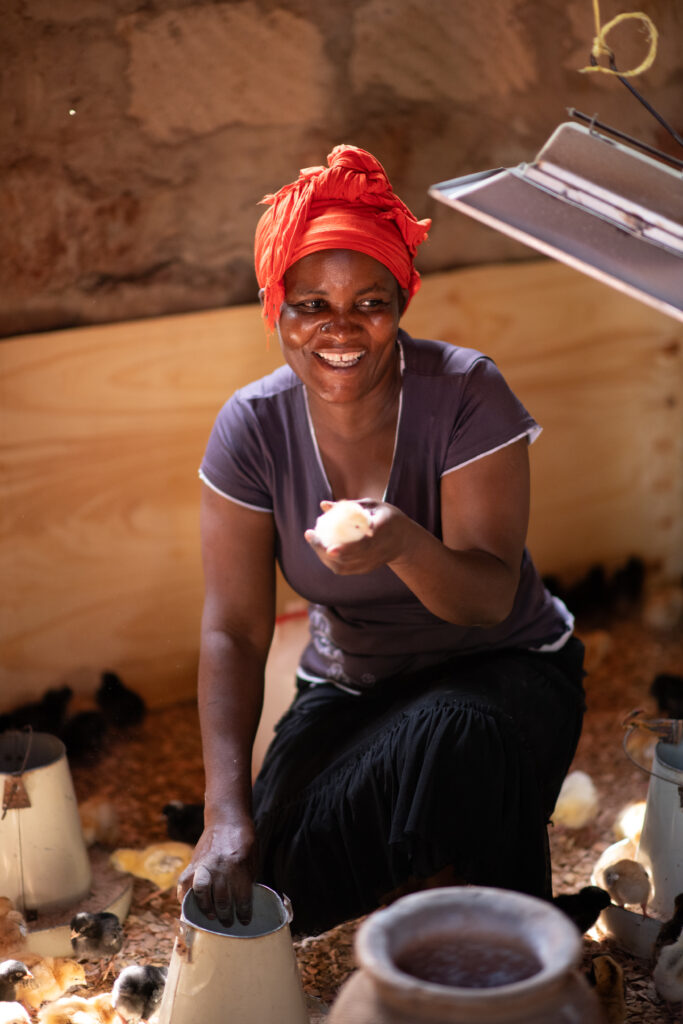
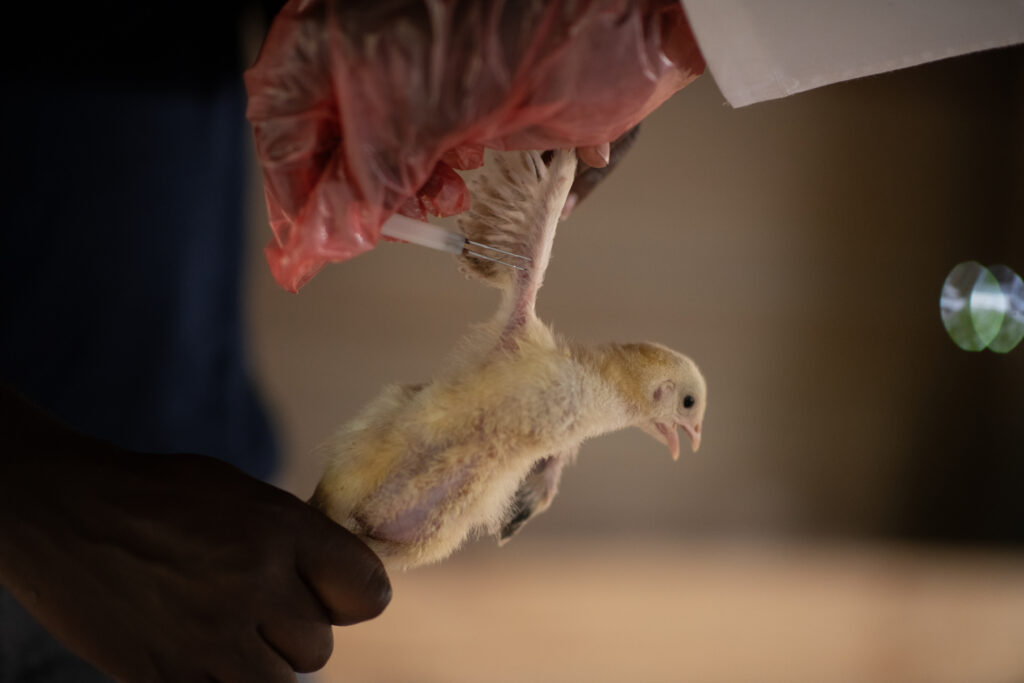
Jane Luvela, a poultry farmer from the Kukubora Poultry Farmers’ Group, with her five-day-old chicks at her homestead farm. Heifer International/Allan Gichigi
Poultry Cooperatives Take Flight in Kenya
On this warm afternoon, Gertrude Abuti, the cooperative’s chairwoman, leads a conversation that is punctuated with good-natured joking and laughter — a sign that times are getting easier for these farmers. Meetings haven’t always been this way. Members might agree that this shift in tone — this joking, this lighthearted laughter — is thanks to their hard work and their commitment to supporting one another, but they would also likely say that much credit is due to Gertrude, nicknamed Gettry, for her visionary and bold leadership.
Founded in 2021, the Kukubora cooperative’s early days were turbulent. Brought together by tough times, members initially met informally, pooling their resources to create a fund to increase their purchasing power for feed and other supplies. The group didn’t have a formal bank account, however. Their savings were mismanaged and soon, the money was lost. This dealt a tremendous blow to the group.
When membership dropped from 50 to 12, Gettry, who was instrumental in helping to create the cooperative, stepped in, intent on opening a bank account for the group, formalizing its status as a cooperative and restoring members’ confidence.
Women Farmers Lead the Way
Around the world, women are vital to their region’s food production. Increasingly, they, like Gettry, are taking on positions of empowered leadership in their communities. Their collective action ripples out to improve livelihoods, resilience and local food systems. This is true in Gettry’s case, too.
“If you empower a woman, you empower the whole community.”
–Eunice Asenah, poultry farmer and mother brooder
Lenna Mutenyo, Kukubora Poultry cooperative member, tends to her seven-day-old chicks at their homestead. Heifer International/Allan Gichigi
After resurrecting the Kukubora cooperative, Gettry worked with members to identify their biggest challenge — and then overcome it. “Very many people feared a one-day-old chick,” she said.
By this, Gettry meant that “brooding” — the weeks between hatching and when supplemental heat is no longer needed — is the most challenging time for her co-op’s poultry farmers. To survive and thrive, newly hatched chicks need a stable, consistently warm environment, but Kukubora’s farmers lacked the equipment to provide this; as a result, they often lost chicks to overheating and cold. Additionally, chicks would die from thirst, malnutrition and disease.
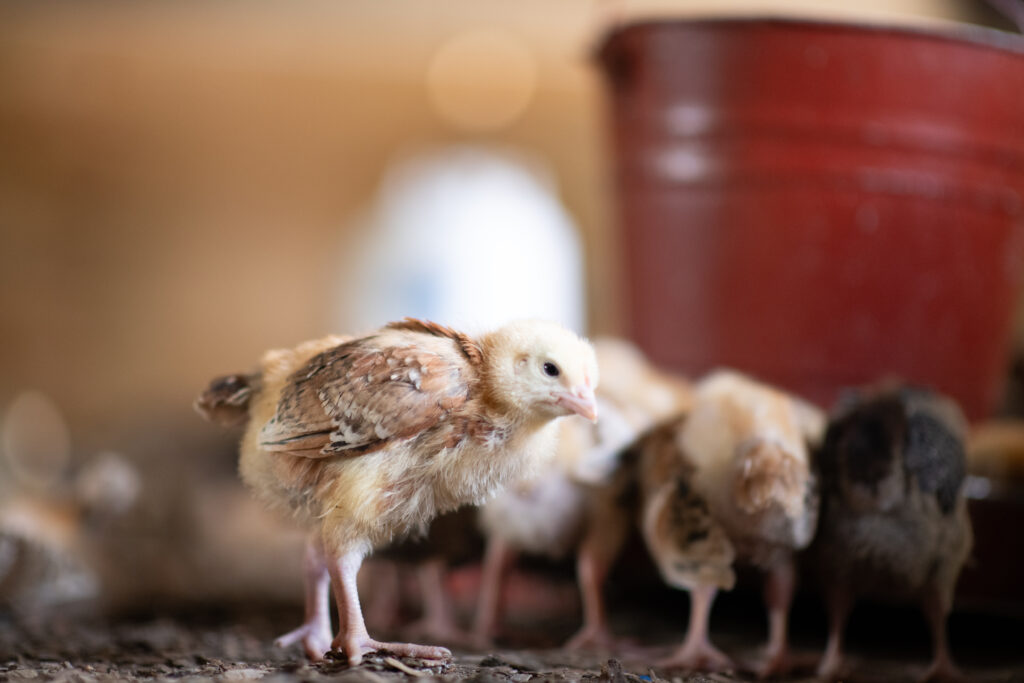
Two-week-old chicks belonging to poultry farmer Emmanuel Kisiangani at his homestead in Kusoki, Kakamega, Western Kenya. Heifer International/Allan Gichigi
Helping Flocks Thrive
Kukubora’s farmers faced other challenges, too. Most relied on indigenous poultry breeds with low genetic potential and low productivity, and they had little access to veterinary care. High feed prices increased farmers’ costs, squeezing already thin, in some cases practically nonexistent, profit margins.
Moreover, across Kenya, markets are dominated by traders and middlemen. Farmers sometimes must sell their animals at extremely low prices either because they’re selling in unfavorable circumstances or they urgently need the funds, or both.
In Kenya and in many countries around the world, most financial institutions such as banks view smallholder farmers as high-risk, meaning most producers lack access to loans and insurance, not to mention business plans to expand their enterprises; some producer cooperatives lack the leadership needed to create collective bargaining power or reliable access to fair and formal buyers or financing.
These many challenges conspire to keep Kenya’s small-scale farmers in cycles of poverty and food insecurity.
Veterinarian Vincent Okoti vaccinates two-week-old chicks at the homestead of Emmanuel Kisiangani in Kusoki, Kakamega, Western Kenya. Heifer International/Allan Gichigi
Many of these circumstances applied, too, to Kukubora’s producers. “Some members even came to the group without shoes [and] their children had dropped out of school because of fees,” Gettry recalled. To address these challenges, Gettry believed that her cooperative must first address the challenges inherent in brooding healthy chicks. At that time, the cooperative’s farmers were brooding their birds independently, on their own farms. If the cooperative could only bring its members together — to brood their birds collaboratively, Gettry said, it would allow them to work together to improve their brooding methods.
It would also allow them to address the costs of brooding collectively. “Because if you keep 100 chicks, you will use one sack of charcoal. And at the same time, if you brood 700, you will still use the same one sack of charcoal,” she said. “Somebody brings 50 chicks, another and 30 chicks, another and 20 chicks, and we brood together to reduce that production cost too.”
Under Gettry’s leadership, the cooperative made this shift. Things began to improve for Kukubora’s farmers, but so much more was still possible.
Eunice Asenah, a poultry farmer from the Kukubora Poultry Farmers’ Group, walks alongside her flock of chickens. Heifer International/Allan Gichigi
Heifer Partnership Broods Hope
In 2023, Heifer International launched a project whose aim was to work alongside Kenya’s smallholder farmers to overcome poverty and food insecurity in their own households and contribute to feeding their communities. Called the Kenya Livestock Marketing and Resilience Project, the efforts are increasing farmers’ access to technology, training and technical assistance, to more profitable markets for poultry and beef and to affordable, legitimate financing.
With support from the Embassy of Sweden in Nairobi, the initiative is expected to collaborate with 38,000 poultry and beef producing households in Kenya by the project’s end in 2027. This number includes the members of the Kukubora cooperative.
Through the project, small-scale farmers gain access to digital and face-to-face extension services as well as improved poultry breeds and feed. By training in climate-smart production practices, record keeping and other skills through the project, farmers and cooperatives are empowered to better manage their enterprises, negotiate higher prices for their products and access formal markets.
Additionally, at least 60 percent of the project’s participants are women and 20 percent are youth. As a result, the project is creating more inclusive enterprises that spread benefits across communities.
“Many women in my community when they saw I was doing well … [I] inspired so many of them and many of them have come back to tell me this project is good and they are earning well.”
–Eunice Asenah, poultry farmer and mother brooder
When an invitation to learn about the Kenya Livestock Marketing and Resilience Project reached Gettry, she decided to attend. “I was invited by Heifer itself,” she said, proudly. “But I don’t know who gave them our name because we were now coming up.… Everybody was talking about us. So when I went there, they said everybody to introduce themselves. Then I stood up and said, I’m Gertrude. I’m from Likuyani. This is what we are doing.”
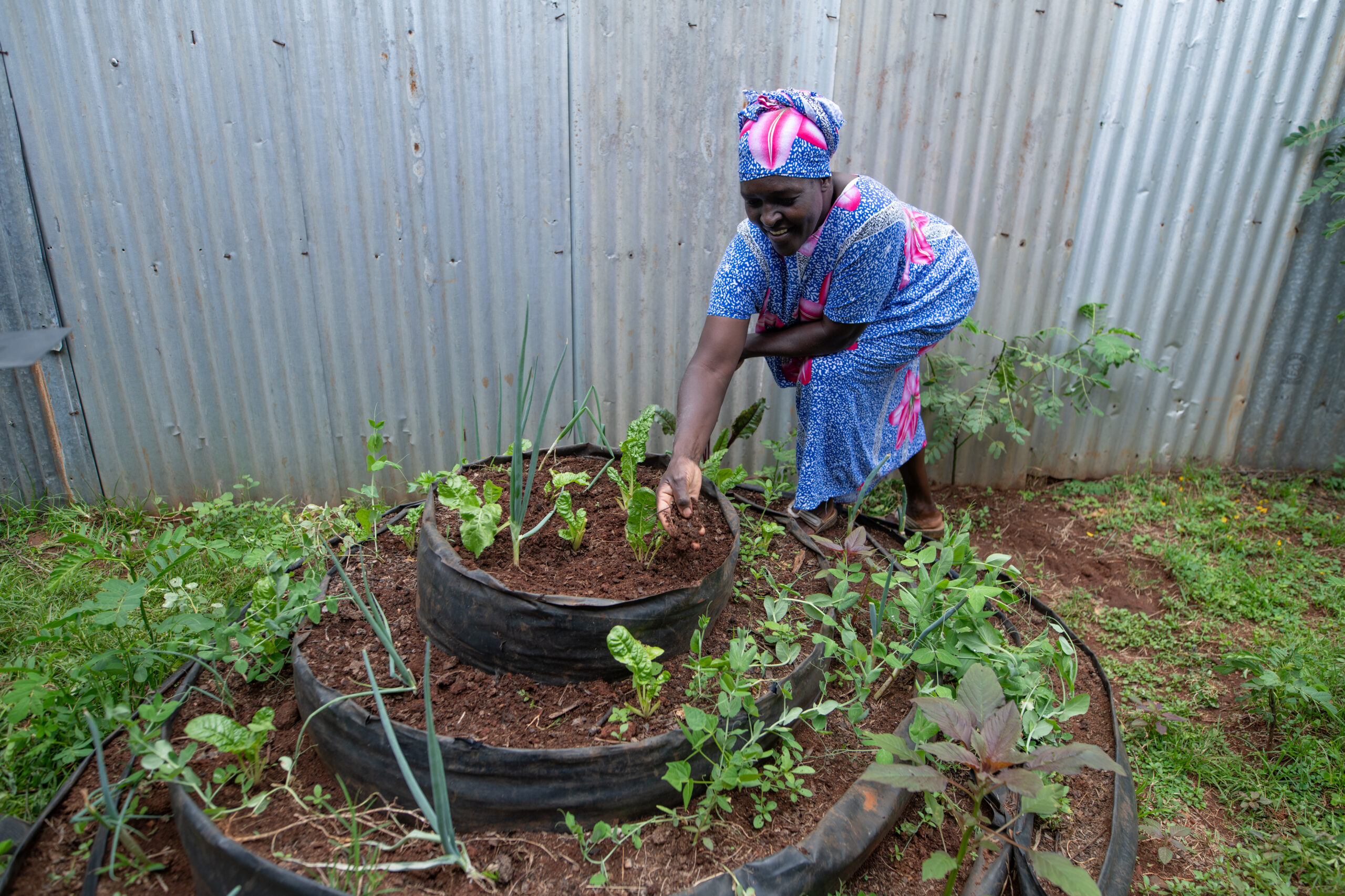
Eunice Asenah in her garden, which was planted using organic manure from the chicken waste at her homestead farm. Heifer International/Allan Gichigi
Gettry’s passion and Kukubora’s organized structure caught the attention of the project’s staff. Kukubora enrolled in the initiative, initially receiving 2,500 chicks, 50 bags of feed, five brooder boxes, a desktop computer and a motorbike to ease chick transportation. As chairwoman, Gettry attended meetings with the project’s organizers and other producers from across the region, learning and exchanging insights and inspiration. She attended trainings in poultry management and then helped train Kukubora’s members.
Eunice Asenah, who began poultry farming in 2018, was among these members. Before joining Kukubora, Eunice struggled. Despite her best efforts at poultry management, her hens often abandoned their eggs and, as a result, the eggs failed to hatch. She also lost many chicks to disease. “I was always going back to square one,” she said.
Eunice’s first breakthrough came after visiting with a successful poultry farmer named Judith who shared insights on her brooding methods.
Inspired, Eunice adopted some of Judith’s methods and saw her own brooding results significantly improve. “That is when I took this business seriously,” she explained. She was still managing the brooding process alone, however, and it was expensive and difficult to expand. Then, she helped form Kukubora.
“With Kukubora, we do it together,” she said.
Paving a Path to Food Security
With support from the cooperative and Heifer, Eunice established herself as a capable mother brooder, one of the co-op’s hubs for raising day-old chicks through their precarious first several weeks. When the chicks are a month old, she supplies the young birds to Kukobora’s members to continue raising or sells them to others in the area. “Many women in my community when they saw I was doing well … [I] inspired so many of them and many of them have come back to tell me this project is good and they are earning well,” she said.
Today, Eunice, Gettry and the rest of Kukubora’s members are earning a more dignified income and are working together to expand the cooperative’s operations and connect to formal markets.
What’s more, the group has created a fund to provide loans to members when they want to invest in their farms or if they face unexpected obstacles: Today, when a farmer can’t afford to purchase chicks or wishes to build a poultry house, the cooperative helps them. If a member faces a health crisis or economic hardship, the cooperative helps then, too.
Globally, women farmers make up about 40 percent of the agricultural workforce; the number is even higher in low-income countries. The leaders of Kukubora Poultry Farmers Group are just one example of so many women farmers whose collective efforts not only strengthen food systems but create safety nets and opportunities for others.
“If you empower a woman,” emphasized Eunice, “you empower the whole community.”
Please be patient while we send you to a confirmation page.
We are unable to process your request. Please try again, or view common solutions on our help page. You can also contact our Donor Services team at 855.9HUNGER (855.948.6437).
-
includes to cover payment processing costs.
Give in Honor
You'll have the opportunity to fill out a free card after your donation
Details
,
Success!
Please be patient while we send you to a confirmation page.
We are unable to process your request. Please try again, or view common solutions on our help page. You can also contact our Donor Services team at 855.9HUNGER (855.948.6437).
Your Donation Amount
/mo
/yr
includes to cover payment processing costs.
Give in Honor
You'll have the opportunity to fill out a free card after your donation