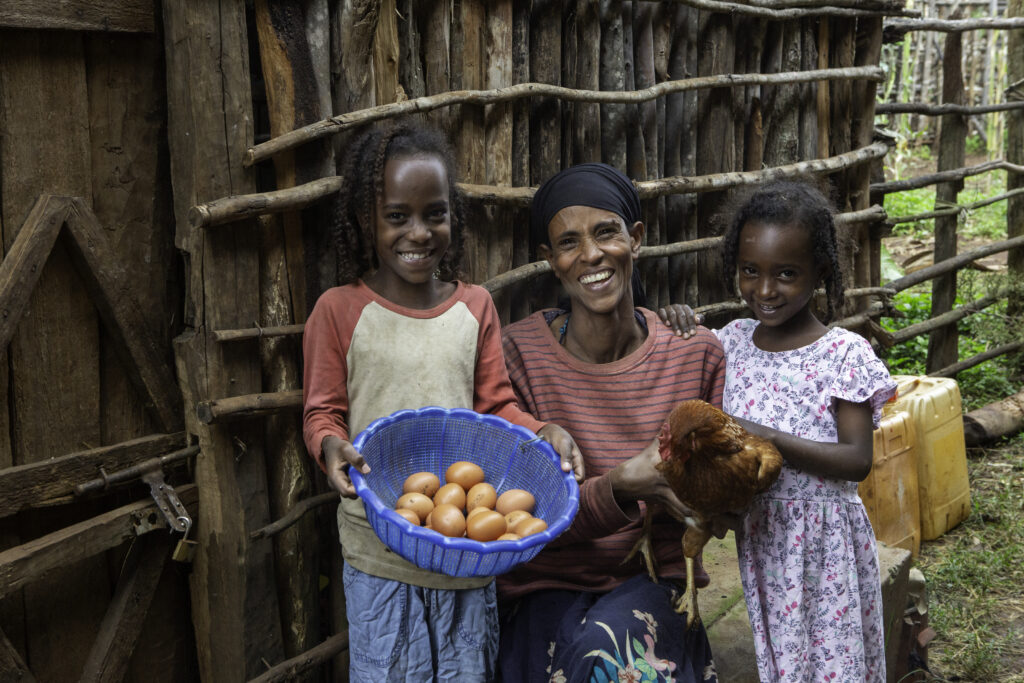
Mihret Aseraro holds a basket of eggs collected from her flock in Yewerie Gojae village, Ethiopia. Photo by Heifer International/Russell Powell.
Beside a small house in Yewerie Gojae village in Ethiopia’s Gurage Zone, protected from the midday heat beneath a corrugated metal roof, Mihret Aseraro glances down at her wrist. Thin, with strong cheekbones and a pleasant smile, the mother of six rests her eyes on a fragile reminder of a time when her family’s world almost fell apart.
Though Mihret is in her 30s, she wears a child’s bracelet. The pastel plastic beads look tiny against her skin, but they carry the weight of a miracle. The bracelet belongs to her 11-year-old daughter, Tsega, a gift from doctors in Israel, where the young girl underwent life-saving heart surgery.
When Tsega returned home in the summer of 2025, her chest bore a long, deep scar, and her family bore profound anxiety. Around the same time, Mihret received 30 female chicks and 150 kilograms (331 pounds) of poultry feed from Heifer Ethiopia as part of the Enhancing Livelihoods of Smallholders Through Improved Poultry Business project. The two-month-old chicks arrived at Mihret’s home at just the right time.
“I would always wonder where I would buy the eggs. That used to be my main concern.”
— Mihret Aseraro
In rural Ethiopia, where women frequently carry the heaviest burdens of household food security amid persistent financial struggles, a mother’s worry about nutrition is an everyday battle.
“The doctors told us that in order for her to fully rehabilitate and heal after the surgery, she needed an unlimited amount of eggs and milk,” Mihret recalled, her voice softening. “I would always wonder where I would buy the eggs. That used to be my main concern.”
Then the chicks grew into hens and started laying between 25 and 27 eggs a day. Mihret gives three eggs to Tsega daily and saves a few for the rest of the family as well.
“I don’t know what I would have done, how I would have taken care of her,” Mihret said. “But thank God to Heifer and the project, I am able to feed my daughter all the eggs she needs without having to pay anything.”
Today, Tsega is back to attending school and playing with her siblings, though she attends regular follow-up appointments with doctors. For Mihret, the flock quickly transformed from a mere resource into the foundation of her family’s health, livelihood and growing poultry business.
Mihret poses with her daughters, Tsega, 11, left, and Eden, 7, right, alongside eggs collected from the family’s chickens. Photo by Heifer International/Russell Powell.
“Their father used to work nonstop, and I wasn’t supporting him financially because I was a housewife. I would only get involved in the farming,” Mihret said. “But now, after we started raising hens and selling the eggs, everything has gotten a lot better.”
Mihret had long dreamed of building a more secure future for her family. Her husband, Misganu, worked as a local subdistrict manager, but his salary of 4,000 birr ($26.93) a month before taxes couldn’t keep pace with the needs of the household that included his mother, Lakech, and sister, Lidet. The family routinely had to take out loans for clothes and shoes. While they also farm leafy greens and enset, a crop also known as false banana, and sell what they do not consume, most of their income previously relied on Misganu’s salary.
The Foundation of the Household
By starting a poultry business, Mihret completely transformed the traditional economic dynamics of her home. Previously, local chicken breeds yielded only around 68 eggs a year — far too few to nourish her family or generate income. But the high-yielding Lohmann Brown breed supplied by Heifer Ethiopia changes that dynamic, producing more than 300 eggs annually. Today, Mihret’s flock produces between 25 and 27 eggs every single day.
Mihret manages this daily micro-enterprise with precision. After keeping three eggs for Tsega’s rehabilitation and a few for her other five children, she sells the surplus to neighbors for 18 birr ($0.11) each. Her husband deposits the income she earns into a savings account. As her savings grow, the extra income has already made a profound difference — lifting the burden of taking out loans for shoes and clothing while allowing Mihret to easily cover school supplies for her children.
“But now, after we started raising hens and selling the eggs, everything has gotten a lot better.”
— Mihret Aseraro
Looking ahead, Mihret plans to expand her business by adding more hens and enlarging the coop. Next on her list is buying an improved-breed dairy cow that can provide more milk for her children, as her local cattle yield very little.
Every extra egg sold or cup of milk poured goes straight into her family’s future — paying for school, doctor visits and better meals. But a woman’s success rarely stops at her own doorstep. Through shared wisdom, mutual support and traditions of Passing on the Gift® — the essence of Heifer’s cornerstone of gifting livestock and training to another family — women like Mihret build a safety net for everyone around them.
Paying Forward the Community’s Solidarity
In Yewerie Gojae village, mutual support is a deeply rooted way of life. When Tsega was sick, Mihret’s neighbors and relatives stepped in to help raise funds. When Tsega returned after surgery, the community flooded the family’s home to offer emotional solidarity. Had it not been for the eggs her hens laid, Mihret would have had nothing to serve her guests to express her gratitude for the role they played in her daughter’s recovery.
Her vision goes far beyond saying thank you. Mihret has stepped up as an elected volunteer leader of a local community group designed to advise 10 to 30 households on critical matters like hygiene and health. Through this platform, she has become an educator, sharing the climate-smart technical knowledge she learned through Heifer-supported trainings.
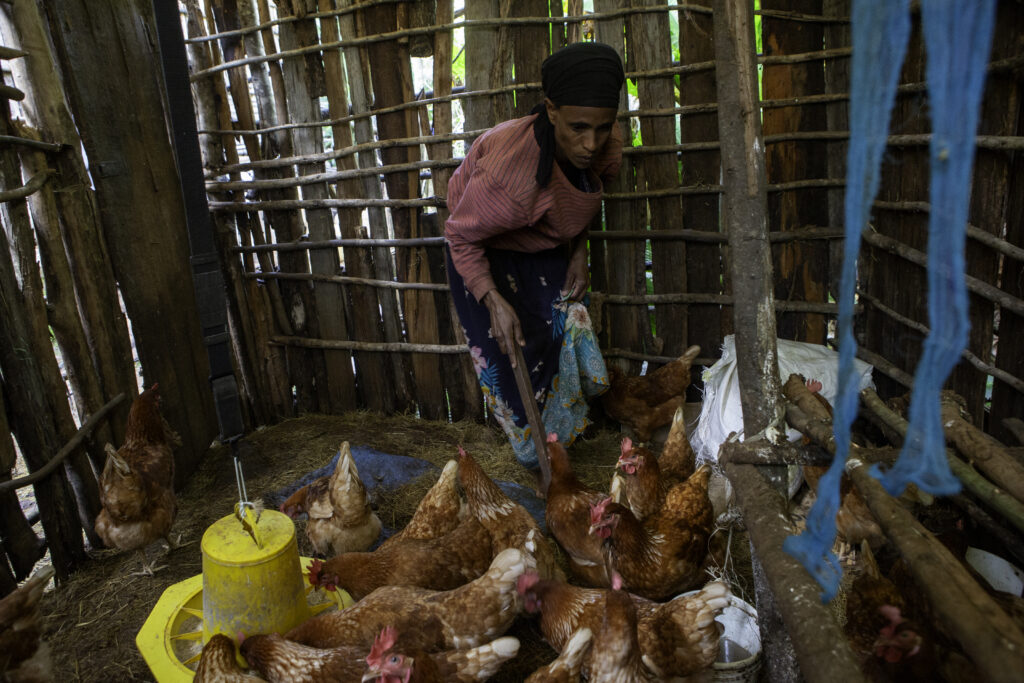
Mihret learned proper coop sanitation, structured three-times-a-day feeding schedules and how to thoroughly clean and dry the chickens’ food and water dishes to prevent disease. She also takes pride in showing other women how using chicken droppings as fertilizer can make their backyard crops highly productive and beautiful.
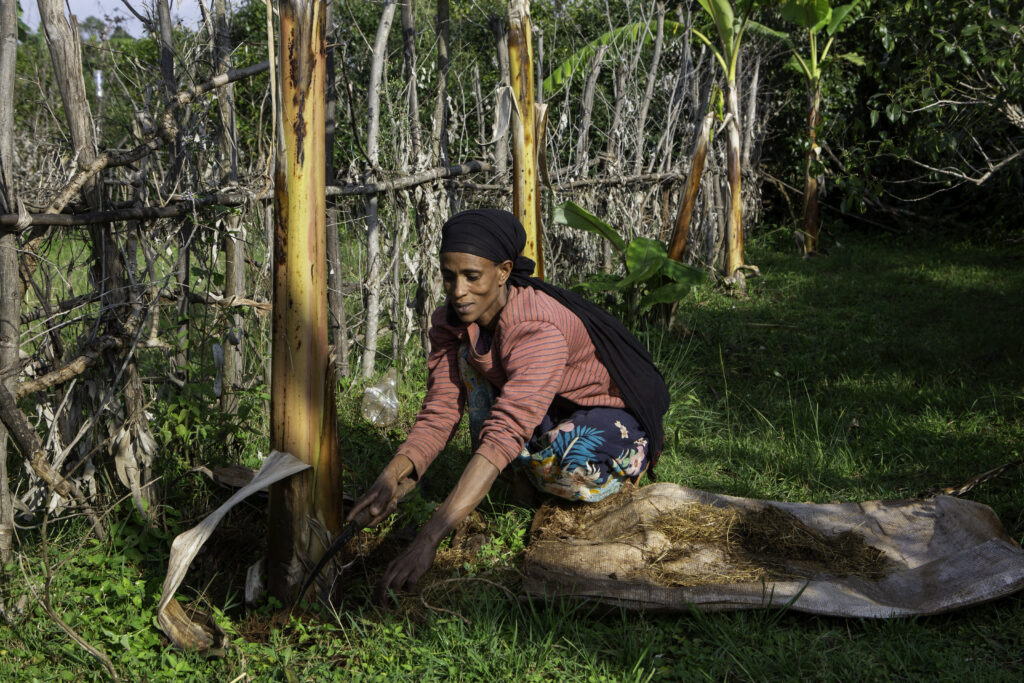
Mihret collects chicken manure from her coop to use as fertilizer on her crops in Yewerie Gojae village, Ethiopia. Photo by Heifer International/Russell Powell.
“I also have a dream to teach other people, to make sure other members of our community fully understand and know that getting involved in chicken raising is very successful,” she said. “I just want to help the subdistrict and local community with the small amount of knowledge that I have.”
Quiet Acts of Generosity
Mihret applies fertilizer made with chicken manure to an enset plant, also known as false banana. Photo by Heifer International/Russell Powell.
While Mihret works toward building up her flock to formally Pass on the Gift, she is already practicing her own quiet version of community care. Every 15 days, she packs up three to five fresh eggs from her own supply and brings them to a blind woman in her village whose daughter is busy caring for an ill son. It is a quiet, powerful act of mutual aid between neighbors.
“It’s not only this woman that I would want to help,” Mihret said. “There are a lot of people I would love to help, but my current financial status doesn’t allow me to help everybody.”
Glancing down at the pastel plastic bracelet on her wrist, Mihret sees how far her family has come. For Mihret, healing did not end with her daughter’s recovery. It became the beginning of a much larger commitment to strengthen her family, support her neighbors and help build a more resilient community.
Breaking Barriers: An Ethiopian Beekeeper’s Story of Resilience
By Sefanit Yismaw|May 5, 2025
Workeye Endris, a 29-year-old mother of six from Asosa, Abrahamo Woreda, is breaking long-standing gender barriers in beekeeping and boosting livelihoods in her community.
Please be patient while we send you to a confirmation page.
We are unable to process your request. Please try again, or view common solutions on our help page. You can also contact our Donor Services team at 855.9HUNGER (855.948.6437).
-
includes to cover payment processing costs.
Give in Honor
You'll have the opportunity to fill out a free card after your donation
Details
,
Success!
Please be patient while we send you to a confirmation page.
We are unable to process your request. Please try again, or view common solutions on our help page. You can also contact our Donor Services team at 855.9HUNGER (855.948.6437).
Your Donation Amount
/mo
/yr
includes to cover payment processing costs.
Give in Honor
You'll have the opportunity to fill out a free card after your donation