If you ask the average American to tell you about Nepal, you’re likely to get answers limited to the Himalayas and the yeti. If you’re really lucky, someone might mention that the country’s flag is the only one in the world that’s not a rectangle.
But there’s certainly more to Nepal than mountains and mythical monsters, including multiple UNESCO World Heritage sites and national parks. While we’re at it, here are 10 more things to know about Nepal.
A view on the path to Everest Base Camp in Sagarmatha National Park. Photo by Daniel Prudek via Big Stock.
1. It’s more than Mt. Everest
Eight of the world’s 14 highest peaks — yes, including the very tallest,Mt. Everest— are located in Nepal. Although about 75 percent of the country is mountainous, you can also find temperate forests and flatland plains ecosystems.
Monkeys on the side of the road in Banke National Park. Photo by Joe Tobiason.
2. The animals are wild
Notable fauna in Nepal include Bengal tigers, one-horned rhinos, clouded leopards, red pandas, wild yaks, several species of monkeys and Himalayan wolves.
Lumbini, the birthplace of Buddha. Photo by Jason Woods.
3. It’s home to Buddha’s birthplace
Siddhartha Gautama, more famously known as Buddha, was born inLumbini, Nepal, between 623 and 480 B.C.
More than 80 percent of people who live in Nepal are Hindu. Photo by Joe Tobiason.
4. It’s the most Hindu country
More than 80 percent of Nepalese identify with Hinduism, making it the country with the highest percentage of Hindus.
Pashupatinath is the largest temple in Nepal. Photo by Jason Woods.
5. Its largest temple is devoted to Shiva, Lord of the Animals
The largest temple in Nepal is Pashupatinath, which is dedicated to Hindu god Shiva. Located in Kathmandu and abundant with monkeys, Pashupatinath comprises 518 buildings and structures. The age of the temple is undetermined, but some say it goes back to 400 B.C. Open-air cremation ceremonies occur at Pashupatinath regularly, and the remains of the bodies are sent along the holy Bagmati River that runs through the compound.
A cow roams the street in Pokhara, Nepal. Photo by sassyphotos on Big Stock.
6. Cows are sacred
Since cows are holy for Hindus, it is a crime to kill a cow in Nepal. However, eating beef is not illegal. Many people in Nepal drink milk, and milk from cows and buffaloes is used to make ghee (clarified butter), yogurt, and cheese. Heifer works with smallholder dairy farmers in Nepal – the Milky Way signature program is designed to transform the dairy sector, improve dairy farmers’ livelihoods and double milk production by 2030.
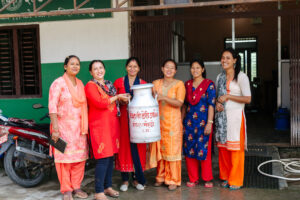
Trilottama Gyawali and members of her women’s group outside her home in Bhairavsthan.
7. You might have a head start on the language
Nepali, a derivative of Sanskrit, is the official language of Nepal. You likely know at least one word of Nepali; the traditional greeting is “namaste,” a word familiar to yoga practitioners the world over.
Heifer Nepal staff members receive a tika in Fattepur.
8. Visitors might get a blessing
In Nepal, people bestow blessings to guests and loved ones by putting a tika on their forehead. A mixture of vermillion powder, yogurt and rice — or sometimes just the powder and water, a tika gives health and good fortune to the wearer. Tikas are common during festivals like Dashain and Tihar.
Many men in Nepal sport the topi hat. Photo by Joe Tobiason.
9. There’s a national hat
Men in Nepal sometimes wear Dhaki topis, or brimless, fabric hats. A symbol of Nepalese nationality, the hat got its name from fabric that used to be imported from the capital of Bangladesh. They gained popularity in the 1950s, when King Mahendra insisted that men wear a Dhaki topi in photographs for official government documents like passports.
Linge ping swings are not as common as they used to be in Nepal, but they’re still a good time. Photo by Jason Woods.
10. You can find the coolest swings there
A linge ping is a giant swing constructed from bamboo and rope that is traditionally built during the festival Dashain. Although less common now, they can still be found during the festival in rural areas, where there’s more space to build and enjoy them.
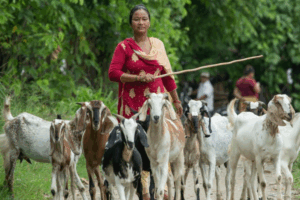
Uma Sinjali Magar walks with her goats in the Chitwan district of Nepal.
Heifer’s Work in Nepal
What does Heifer do in Nepal?
Heifer has deep roots in Nepal going back decades – we’ve worked on projects in Nepal since 1997. Our goal is to train and support farmers — especially women — to reach new markets, raise better livestock and earn more money.
Our partner farmers in Nepal work with many agricultural products, including dairy, goats, poultry and eggs, fruits, vegetables, and grains.
In collaboration with local governments and nongovernmental organizations (NGOs), Heifer Nepal connects self-help groups and cooperatives to strengthen communities.
Why does Heifer work in Nepal?
Agriculture is central to Nepal’s economy, supporting a majority of households and employing about two-thirds of the population.
In Nepal’s lower-altitude zones, fertile land and abundant water provide the potential for agricultural development. But limited access to modern farming techniques reduces efficiency, and climate-driven weather changes threaten crops.
In addition to our agricultural work, we work to reduce flood risks, create disaster preparedness programs and build infrastructure to protect communities from weather effects. When the worst happens, we provide disaster rehabilitation for events like the August 2026 Nepal floods that devastated districts along the Nepal-Tibet border, which affected Heifer program areas.
The leadership team for Bihani Dairy stands outside their facility in Nepal. Photo by Joe Tobiason.
Tulsi’s Story: The Women of Bihani Dairy Give Back
Tulsi Thapa once depended on her husband for income. Now, she’s a founding member of Bihani Dairy: a women-led dairy business.
Bihani Dairy invests most of the money it earns back in the community, with the rest reserved for further improvements for the business.
The Milky Way Program: Nepali Smallholders Lead Dairy Sector Transformation
By Peter Goldstein|June 24, 2024
The Milky Way program is driving sustainable change in Nepal’s dairy sector, supporting smallholder farmer incomes, increasing milk production and advancing the local government’s goal of raising dairy standards.
Please be patient while we send you to a confirmation page.
We are unable to process your request. Please try again, or view common solutions on our help page. You can also contact our Donor Services team at 855.9HUNGER (855.948.6437).
-
includes to cover payment processing costs.
Give in Honor
You'll have the opportunity to fill out a free card after your donation
Details
,
Success!
Please be patient while we send you to a confirmation page.
We are unable to process your request. Please try again, or view common solutions on our help page. You can also contact our Donor Services team at 855.9HUNGER (855.948.6437).
Your Donation Amount
/mo
/yr
includes to cover payment processing costs.
Give in Honor
You'll have the opportunity to fill out a free card after your donation