A youth-led mobile coffee shop serves locally grown coffee in Oaxaca, Mexico. Photo courtesy of Heifer Mexico.
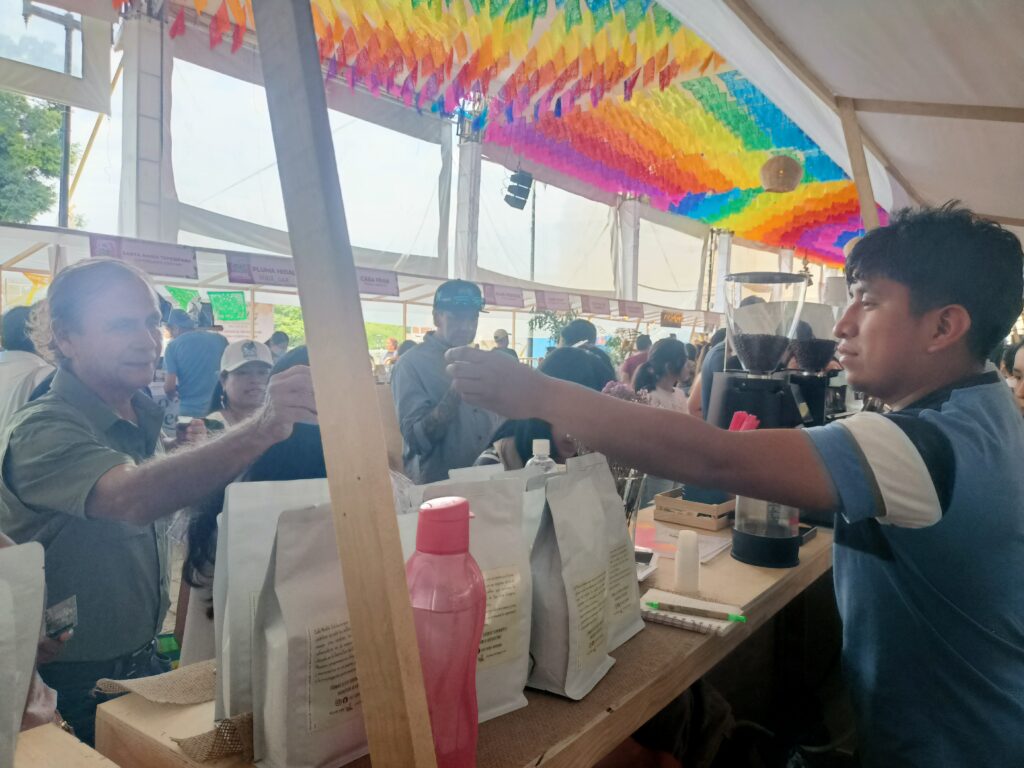
Aléxander Yair Jose Riaño, right, serves coffee to a customer at the 2026 Oaxacan Coffee Convention. Photo by Heifer International/Eduardo Molina.
For young people in Oaxaca, Mexico, coffee can offer more than a family livelihood. It can be a path to entrepreneurship, a source of income and a reason to build a future close to home. The Mobile Coffee Shops project creates these opportunities for young people in Mexico. Heifer International Mexico promotes the project as part of its Promesa Café y Cacao signature program, which seeks to help women and young people earn more from coffee through sustainable and innovative business models.
The project is based on a strategic model: to involve coffee-growing families — especially their younger generations — in not only producing coffee beans but also in processing, preparing and directly marketing coffee. This approach adds value to the families’ products and diversifies their income streams.
It also reflects Heifer Mexico’s institutional strategy to strengthen sustainable agribusinesses, foster youth entrepreneurship and connect producer organizations with more inclusive markets.
Three Ventures With a Shared Purpose
As part of this strategy, three “cafetería” motorcycles — compact, three-wheeled mobile coffee shops equipped to prepare and serve coffee — were delivered in 2026 to different regions of Oaxaca, Mexico. Each supports a youth-led business built around coffee produced by local families. In addition to providing the mobile coffee shops, Heifer Mexico offered barista training and helped participants take part in regional fairs and state-level events, including the Oaxacan Coffee Convention.
Café Niebla Solidaria
Located in San José Zaragoza, in the municipality of Santa Cruz Itundujia in Oaxaca’s Sierra Sur region, Café Niebla Solidaria is led by four young people — three women and one man. All four come from coffee-producing families and are carrying on their families’ agricultural traditions through their own venture.
Among them is Lisseth Maria López Riaño, 22, who serves as president and head of design and communications.
“For us, [the project] has meant adding value to the coffee produced in our region,” Lisseth said. “Before, we saw it as a product that was simply harvested and sold. Now we can process it and offer it directly to customers.”
Their initiative demonstrates that young people can lead rural businesses by preparing and serving specialty coffee grown by their families, providing coffee break services, participating in community fairs and selling their region’s coffee directly to customers. In addition to building skills in barista techniques, administration and customer service, the model integrates the entire value chain — from production to the final cup — and creates another source of income for producer families through sales of coffee drinks and other coffee-based products, reducing their reliance on international coffee markets.
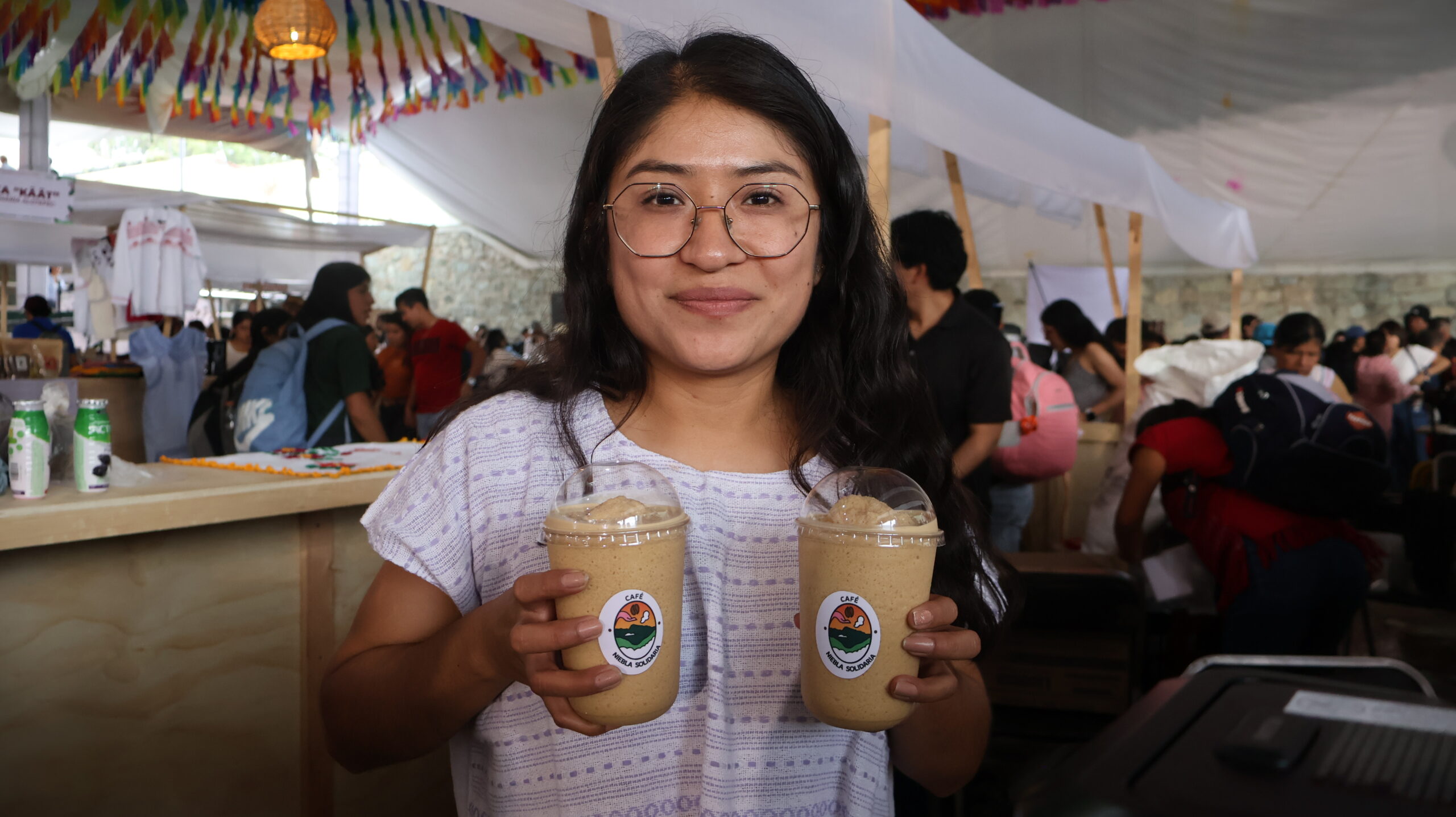
Elizabeth López Riaño holds two drinks from Café Niebla Solidaria at the 2026 Oaxacan Coffee Convention in Oaxaca, Mexico. Photo by Heifer International/Eduardo Molina.
Between February and June 2026, Café Niebla Solidaria recorded sales totaling 39,905 Mexican pesos (approximately $2,090) from 571 beverages sold over 25 days of operation in various communities and at events in Oaxaca’s Sierra Sur region. The total sales over this timeframe represent an average of nearly 1,600 Mexican pesos per operating day, offering an early indication of the venture’s commercial potential as the team continues to hone its entrepreneurial and business skills.
“We want to become a bridge … [that] shows other young people that coffee doesn’t end with the harvest.”
— Lisseth Maria López Riaño
Beyond the revenue generated, these results reflect a process of continuous learning. Each day behind the counter sharpens young entrepreneurs’ skills in customer service, inventory control, administration, logistics and specialty coffee marketing, equipping them to manage their businesses and lay the groundwork for future growth.
Lisseth said one of the team’s biggest hurdles has been managing a new business while trying to grow it. Operating from a rural community has also presented transportation and supply challenges. Even so, the venture has opened doors beyond their community.
“The mobile coffee shop has allowed us to reach other communities and spaces, meet new people and represent Zaragoza and the Sierra Sur,” she said.
For Lisseth, success means more than a thriving coffee business. She hopes Café Niebla Solidaria will continue to grow, reach more communities through regional events and inspire other youth to pursue similar endeavors.
“We believe other young people can be motivated by this venture and look for opportunities without having to leave their communities,” she said.
Cafecito Entre Nubes
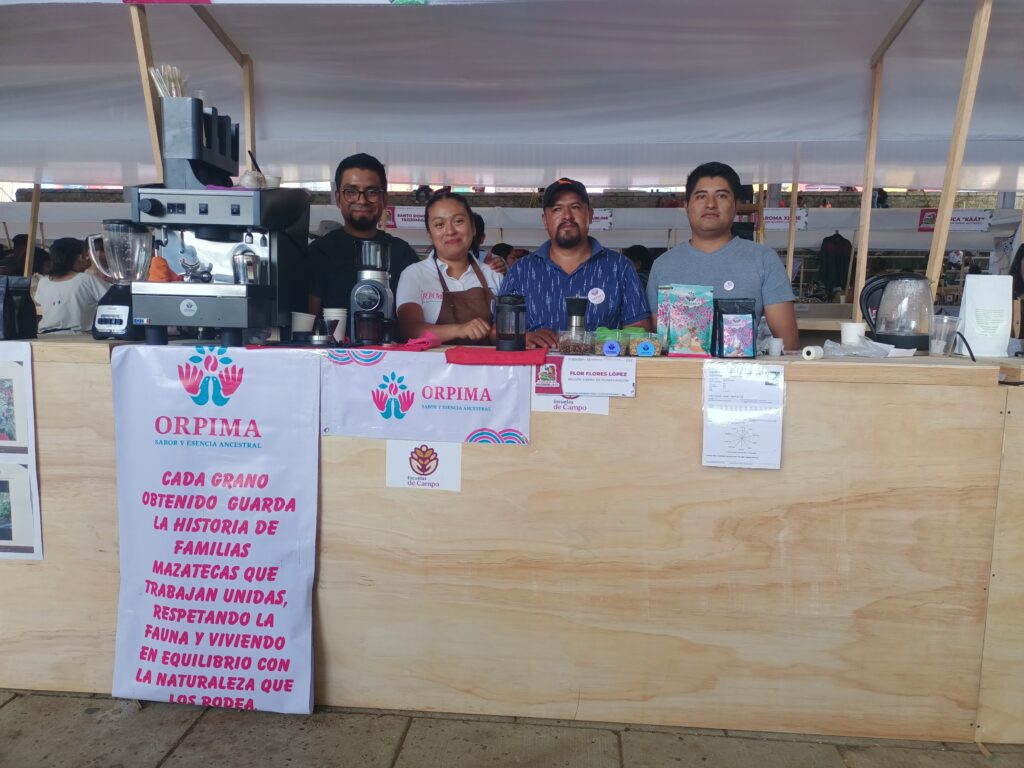
ORPIMA cooperative members Jose Antonio Carrera Palacios, Epifanio Marin Marin, Salvador Moreno Rosette and Mireya Hernandez Bautista at the 2026 Oaxacan Coffee Convention in Oaxaca, Mexico. Photo by Heifer International/Eduardo Molina.
In the Sierra Mazateca, the cafetería venture Cafecito Entre Nubes is led by members of the cooperative Regional Organization of Mazatec Indigenous Producers (ORPIMA). Their mission is to bring specialty coffee to various communities in the region — including Huautla de Jiménez, San Mateo Yoloxochitlán, Santa Cruz Acatepec and Santiago Tenango — delivering a product with a distinct regional identity directly to consumers and expanding the commercial presence of coffee produced by Mazatec families.
Café Alma de Nube
The third venture, Café Alma de Nube, is located in San Gabriel Mixtepec, in Oaxaca’s Costa region. It is promoted by the local communal property authorities, a governing body that makes community decisions through a local assembly. The mobile coffee shop offers an alternative way to diversify community income, support local organization and create economic opportunities for younger generations in the coffee sector.
A Future in Coffee, Close to Home
The initial results of Café Niebla Solidaria, along with the launch of Cafecito Entre Nubes and Café Alma de Nube, suggest that this model of family participation across the coffee value chain offers another way to diversify rural economies in Oaxaca.
Every cup served represents a chance for young people to remain in their communities, innovate based on their families’ coffee-growing legacy and contribute to building more inclusive, resilient and sustainable food systems where they live.
For Lisseth, the measure of success isn’t just how far Café Niebla Solidaria can go, but who might follow.
“We want to become a bridge … [that] shows other young people that coffee doesn’t end with the harvest,” she said.
Please be patient while we send you to a confirmation page.
We are unable to process your request. Please try again, or view common solutions on our help page. You can also contact our Donor Services team at 855.9HUNGER (855.948.6437).
-
includes to cover payment processing costs.
Give in Honor
You'll have the opportunity to fill out a free card after your donation
Details
,
Success!
Please be patient while we send you to a confirmation page.
We are unable to process your request. Please try again, or view common solutions on our help page. You can also contact our Donor Services team at 855.9HUNGER (855.948.6437).
Your Donation Amount
/mo
/yr
includes to cover payment processing costs.
Give in Honor
You'll have the opportunity to fill out a free card after your donation