

Drinking a cocktail of raw eggs, brandy and heavy cream, kissing under the sprig of an invasive plant, nailing our socks to the mantel … if you think about any holiday tradition long enough, you’ll start to realize that, out of context, even our most common Christmas-time celebrations are delightfully bizarre.
In the spirit of the most wonderful(ly weird) time of the year, we’re exploring weird Christmas traditions around the world. From a mysterious Christmas pickle ornament to a caroling horse skull, these Christmas customs from the United States and beyond are as delightful as they are strange.
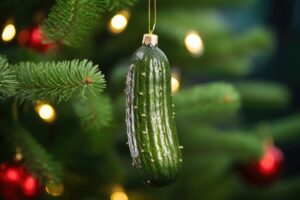
Decorating Your Christmas Tree With…Pickles?
Origin: Unknown
If you’ve perused the Christmas section of any ornament-selling store, you’ve probably seen at least one sparkling glass pickle. What’s the story behind the Christmas pickle tradition? Popularly touted as an Old-World German tradition, the Christmas pickle (or Weihnachtsgurke) is hidden deep in the boughs of the Christmas tree on Christmas Eve for children to find on Christmas morning. The first one to find the pickle in the Christmas tree gets a special gift or is given the honor of opening the first present. Whether or not this tradition’s origin story is true is up for debate. Turns out, no one really knows. Even the Germans. According to a 2016 survey cited in reporting on the tradition, 91% of Germans had never even heard of the Weihnachtsgurke, let alone had one in their homes. Other theories about the legend of the pickle on the Christmas tree hail back to the Civil War and even St. Nicholas himself.
Caroling With a Dead Horse
Origin: Wales
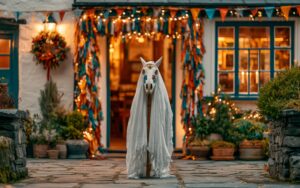
The Mari Lwyd tradition brings a horse skull, singing and a battle of wits to Christmas in Wales.
As the legend goes, during the holidays in Wales, the dead horse Mari Lwyd rises from the grave, then goes door-to-door challenging those who dare to a rhyming battle of wits. In practice, here’s what that looks like: groups of revelers take a decorated horse skull around and knock on doors. When the door opens, the group will sing Mari Lwyd’s challenge, then start a “pwnco,” or call-and-response rhyme battle with those inside the home, each group trying to outdo the other.
This Welsh Christmas tradition is just one of many eerie customs explored in “You’d Better Watch Out: Holiday Horrors and Truly Terrifying Traditions from Around the Globe.”
Carving Intricate Radish Sculptures
Origin: Oaxaca, Mexico
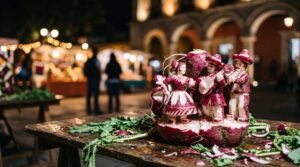
Night of the Radishes, or Noche de los Rábanos, is a Christmas-season radish-carving festival celebrated every December 23 in Oaxaca, Mexico.
The tradition began when merchants tried to attract shoppers on their way to and from Christmas church services with intricate vegetable displays. The merchants carved radishes into people, animals and other decorative shapes. The most imaginative and skillfully carved radishes would be snatched up to be used as centerpieces on holiday tables.
In 1897, Oaxaca’s mayor officially declared December 23 to be the Noche de los Rábanos, or Night of the Radishes. Each year, professional artists and amateur whittlers transform humble radishes into nativity scenes, alligators, churches, portraits of famous celebrities and other creations.
Elf On The Shelf
Origins: Georgia, United States
Whether you love to hate it or hate that you love it, the Elf on the Shelf Christmas tradition is a young custom that has quickly taken root in many American homes.
For those of you without kids, here’s the premise: Scout Elves help Santa manage his list by embedding themselves into the homes of children and observing their behavior each day. Each night these sleeper agents return to the North Pole with a report for Santa on who has been Naughty and who has been Nice. After delivering their missives, Scout Elves return to their adoptive homes each morning to perch in a new area of the house and wait for their children to find them.
Once discovered, they aren’t supposed to be touched by tiny, human hands, lest their Christmas magic need a little help. But an accidental touch doesn’t mean Christmas is canceled. According to the official guide to what happens if someone touches the Elf on the Shelf, a letter to Santa, cinnamon sprinkled nearby or a Christmas song can help restore the magic. Crisis averted.
An Elf on the Shelf starter kit contains a children’s book, The Elf on the Shelf: A Christmas Tradition, and a posable, apple-cheeked Scout Elf doll that you can name and “officially” adopt into your family. Instead of simply hiding their Scout Elf in a different location each night, some parents have taken a more creative approach, posing their elf around the house in elaborate scenes. The results range from wholesome and delightful to hilarious and a wee bit disturbing.
Note: Surprisingly, this terrifying home invader wasn’t a marketing ploy dreamt up by Mattel or Hasbro. It was a family tradition brought to life by mom Carol Aebersold and her twin daughters Chanda and Christina.

Adding Some Scatalogical Humor To Your Nativity
Origin: Catalonia, Spain
Among Catalan Christmas traditions, the caganer brings an unexpected guest to the nativity scene.
For you, a traditional nativity scene probably includes Mary, Joseph, baby Jesus, some shepherds, the three wise men … you get it. But in Catalonia, an autonomous community in Spain, you’ll notice a strange figure in the corner: a caganer.
A caganer is a bare-bottomed figurine eternally frozen in the midst of answering his call of nature. He or she is placed in the corner or the back of the nativity and left for onlookers to notice. Though historians have traced the advent of the caganer back to the 18th century, no one knows exactly why or how they came to be or what they truly mean. Some scholars suspect that the caganer is a reminder that God will come in His time, regardless of whether his followers are ready or not. Others suspect that 18th-century Catalonians simply had an unmatched sense of humor.
Though traditionally caganers were depicted wearing a white shirt and a traditional Catalan hat called a barretina, today you can find caganer figurines in the likeness of just about anyone, ranging from Vladimir Putin to the Pope to Darth Vader.
Surprisingly, caganers aren’t the only poop-centric holiday tradition in Catalonia. There’s also Caga Tió, or Tió de Nadal. We’ll leave it to you to search for that one. Happy Holidays.

Eat Kentucky Fried Chicken
Origins: Japan
Did you know that an estimated 3.6 million Japanese families treat themselves to a bucket of Kentucky Fried Chicken for Christmas? In 1974, the American fast food chain unveiled their “Kentucky for Christmas!” marketing campaign in Japan. The story goes that KFC spread the idea that it’s a time-honored Western tradition to celebrate Christmas with fried chicken. Although only about 1 percent of people in Japan identify as Christian, there was an exotic appeal to the campaign, and it took off. Today, the tradition is so popular, it’s highly recommended to place Christmas Day orders well ahead of time.
For another taste of festive food traditions, explore “Holidays in Paraguay: Punch, Polka and Poppers.”

Hang Old Oranges Around The House
Origins: Medieval Europe
If you’re looking for that perfect festive, spicy scent so many of us associate with Christmas, look no further than homemade orange and clove pomanders. Once used as protection against the plague, pomanders rose in popularity in 17th- and 18th-century Europe.
These medieval pomanders were round pieces of jewelry that contained smell-good items like rose petals, herbs, flowers or musk. Today, modern pomanders are dried oranges studded with cloves and hung with ribbon. While we know now that these sweetly scented inventions do nothing to ward off sickness, pomanders make cheerful Christmas decorations and fill your home with a lovely aroma.
Find out how to make an orange and clove pomander with “How to Make Your Holiday Medieval and Bright With Pomanders.”

Decorate With (and Destroy) Straw Goats
Origins: Sweden
In Sweden and parts of the northern United States, families adorn their homes and Christmas trees with julbock, or the Yule Goat. Though no one knows exactly why goats figure so heavily in Scandinavian festivities, the Yule Goat was probably invented to honor the mythical goats Tanngrisnir and Tanngnjóstr. In Norse mythology, these giant grazers pulled the god Thor’s chariot and would rise whole and new each morning after being killed and devoured by their master each evening.
Originally part of a winter celebration called Juleoffer, or “Yule Sacrifice,” the Yule Goat was portrayed by a man dressed in goatskins, carrying a goat’s head effigy. At the end of the day, the Yule Goat would be “killed” but, like Tanngrisnir and Tanngnjóstr, would rise from the dead as the Yule sun rose in the sky.
Today, this Swedish Christmas tradition lives on in ornament form. Made of straw and decorated with red ribbon, Yule Goats are hung on Christmas trees or placed under them.

Fun fact: The city of Gävle, Sweden, is famous for erecting a giant straw Yule Goat every holiday season. Since the first Gävle Goat appeared in 1966, keeping it standing has become a holiday saga of its own.
According to Visit Gävle’s history of the goat’s fate, the goat survived the 2024 season unharmed. In 2025, it made it past Christmas, only to collapse on December 27 when Storm Johannes brought winds exceeding 40 meters per second. Apparently, fire isn’t the only thing a giant straw goat has to worry about.
Every year, residents and visitors gather for the goat’s unveiling and hope it makes it through the season. Over the years, some of the attempts to destroy or meddle with it have been pretty weird.
Our Delightfully Unique Holiday Tradition
After all those weird Christmas traditions around the world, giving someone a goat almost sounds ordinary. Almost.
At Heifer International, we have a soft spot for a holiday tradition that starts with a simple question: What do you give someone who already has enough stuff? For many families, the answer is a gift that helps someone else. A donation in a loved one’s honor can support farming families with livestock, training and opportunities to earn a reliable income.